Athletic apparel shoppers know exactly what they want: gear that fits right, moves well, and actually looks the way it’s supposed to. The problem is that buying it online makes all three of those things surprisingly hard to guarantee.
Return rates in athletic apparel consistently run higher than other fashion categories, and that’s not a coincidence. It reflects something specific about how performance clothing is made and how shoppers experience it through a screen.
For e-commerce managers focused on conversion and margin, understanding the root cause is the first step toward fixing it. That’s why this guide explores the main causes of high return rates in athletic apparel and what online retailers can do to reduce them.
What makes athletic apparel returns different from other fashion categories?

Most apparel categories already face sizing inconsistencies. However, athletic apparel takes this challenge even further. For example, a medium in a compression running tight can behave very differently from a medium in a relaxed-fit sweatshirt, even when both pieces come from the same brand.
Stretch fabrics, technical constructions, and performance-oriented cuts all behave differently on the body. As a result, even shoppers who know their size in everyday clothing often have no reliable reference point when purchasing a new sports bra or a pair of cycling shorts for the first time.
This gets more complicated when you factor in how athletic apparel is designed to be worn. A fitted yoga legging is supposed to sit close to the body. A training top might need to allow for a full range of motion. A running jacket needs to layer over other pieces.
The intended fit is almost always specific to the activity, and that level of specificity is extremely difficult to communicate through a standard size chart.
As a result, when shoppers cannot trust their size, they typically respond in one of two ways. On one hand, they may purchase multiple sizes to try at home and decide later. On the other hand, they may hesitate altogether and ultimately abandon the purchase.
Both outcomes are costly. The first drive returns, while the second drives abandonment. Neither one is a sign that the shopper wasn’t interested in the product.
But sizing uncertainty is only part of what’s working against you. Even shoppers who feel reasonably confident about their size face a second, equally frustrating barrier.
Related: Why clothing sizes are inconsistent across brands
The Visual Gap Between Product Page and Reality on Athletic Apparel
Even when sizing isn’t the primary issue, shoppers still struggle to visualize how a piece will actually look on them.
A product photo on a model with a very different body type often fails to answer the real questions shoppers are trying to resolve. For instance, will this be too tight through the hips? Will the waistband sit where I expect it to? And will the length actually work for my body?
Those unanswered questions create hesitation at the exact moment a purchase decision should be happening. And in a category where fit is so closely tied to performance and comfort, that hesitation is a real conversion problem, not just a minor friction point.
Consider what shoppers are actually evaluating when they land on a product page. They have already expressed intent and are actively engaging with something they want. At this point, the barrier between interest and purchase is not price or brand preference, but rather uncertainty about whether the product will truly work for their body.
Importantly, this uncertainty is entirely solvable, yet most product pages still fail to address it effectively.
Static images and generic size charts leave too many questions unanswered. Shoppers fill those gaps with doubt, and doubt leads to either an abandoned cart or a purchase they’re not fully committed to. When a shopper buys without confidence, there’s really only one place that story ends.
Returns Are a Decision Problem, Not a Fulfillment Problem

Returns are where unresolved doubt shows up in your operations data.
A lot of retailers treat high return rates as a logistics challenge. As a result, they focus on optimizing the returns process, improving packaging, refining exchange flows, and negotiating better rates with carriers. While this work is operationally important, it ultimately addresses the symptom rather than the root cause.
In reality, most returns in athletic apparel occur because the shopper was not fully confident at the moment of purchase. The decision to buy was already fragile, so, the return is just the outcome.
This distinction matters because it fundamentally changes where you should invest to solve the problem. If returns are treated as a fulfillment issue, investment tends to focus downstream. However, if returns are understood as a decision-making issue, then the investment must shift to the point of purchase. Importantly, the evidence consistently shows that the latter approach is far more effective.
In fact, reducing the number of uncertain purchases has a significantly greater impact on return rates than simply making the return process smoother. Paradoxically, a smoother returns experience can even increase return rates by lowering the perceived risk of buying on impulse.
Fixing this requires addressing the confidence gap before checkout, not after. Shoppers need to feel certain about size and fit when making a decision. Yet, size charts, what most retailers are relying on to deliver that certainty, have been failing shoppers for years.
Related: E-commerce logistics for fashion retailers: why returns are the real bottleneck
Why Size Charts Keep Failing Athletic Apparel Shoppers

Size charts have been the default solution to the fit problem for as long as online apparel retail has existed. They’re still almost universally inadequate, and the athletic apparel category exposes their limitations more than almost any other.
A standard size chart maps a set of body measurements to a generic size label. It doesn’t account for how a specific garment is cut, how the fabric behaves under stretch, or whether the brand runs small or large relative to industry standards. It also assumes the shopper knows their own measurements, which most don’t.
Even shoppers who do know their measurements are left to interpret what those numbers mean for a specific product without any useful context. The result is that size charts create the appearance of guidance without actually reducing uncertainty.
Shoppers consult them, get a generic recommendation, and still don’t know if that recommendation applies to the item they’re actually looking at.
For athletic apparel specifically, where the margin for error is small and the performance consequences of a poor fit are real, that gap is significant. Closing it requires something fundamentally different from a better size chart. It requires building the confidence to buy directly into the purchase experience itself.
Related: Size Calculators: How They Work and Examples
How a Virtual Fitting Room Changes the Equation
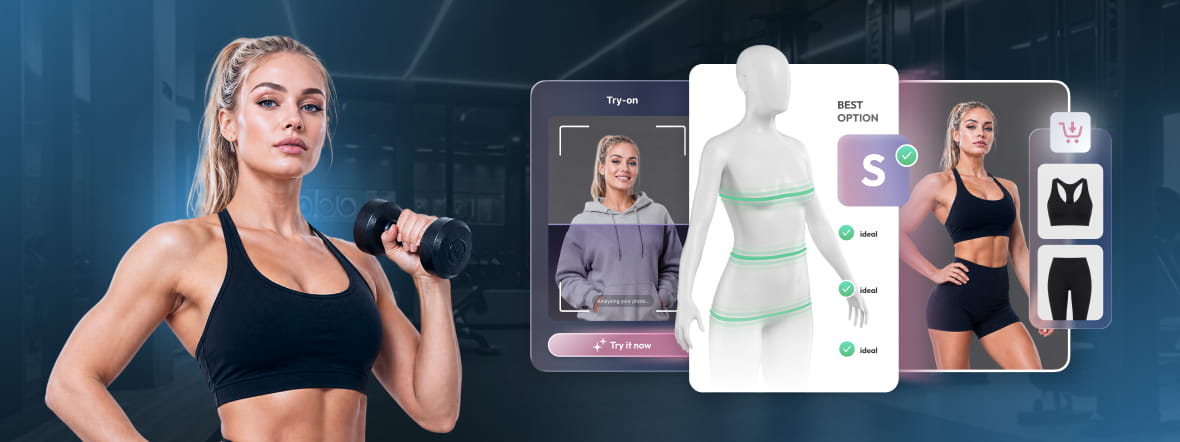
Rather than asking a sportswear shopper to interpret a generic size guide, a virtual fitting room gives them a personalized size recommendation based on their actual measurements and the specific product’s construction. It accounts for the fabric, the cut, the intended use, and how similar shoppers with similar measurements have experienced that garment.
Sizebay’s Virtual Fitting Room works exactly this way. It doesn’t produce a generic size recommendation. It produces a recommendation for that shopper, on that product, informed by real data on how that garment fits across a range of body types.
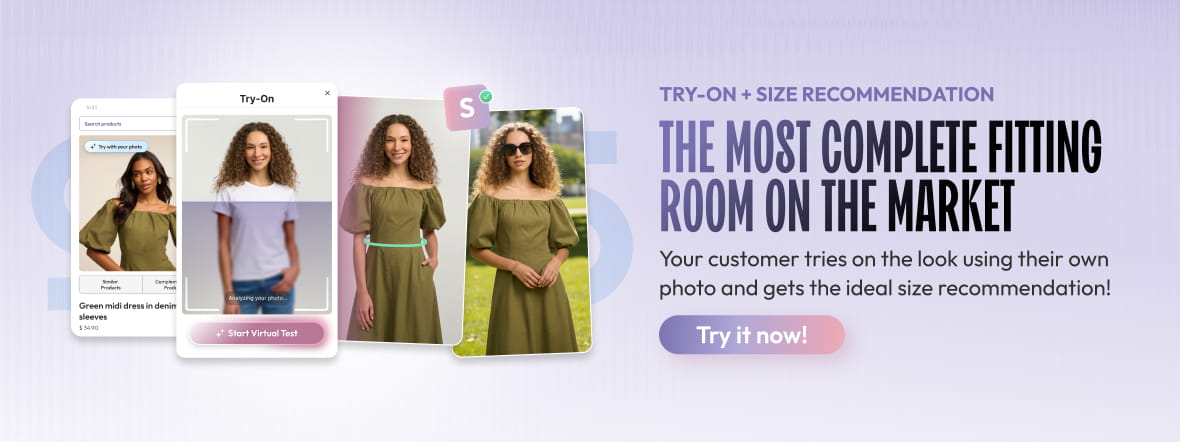
The second layer of the problem, the visualization gap, is addressed through virtual try-on. Shoppers can see how a piece looks on a body that resembles theirs, which answers the questions that product photography consistently fails to answer:
- Does this sit the way I want it to?
- Do the proportions work for my frame?
- Does the length look right?
These are the questions that drive returns when they go unanswered at the point of purchase. Together, size recommendation and virtual try-on create what a shopper actually needs: a complete decision experience that delivers the confidence to buy right the first time. And that confidence has a direct, measurable impact on your bottom line.
Related: E-Commerce product photography guide for fashion retailers
Sizebay Virtual Fitting Room with Try-On and Size Recommendation
Sizebay’s virtual fitting room delivers a personalized size recommendation tailored to each shopper’s body. It takes into account the specific characteristics of the garment, fabric behavior, fit, and real fit data from shoppers with similar body profiles. The result is a shopping experience that feels much closer to trying clothes on in a physical store, giving consumers far more confidence in their purchase decisions.
At the same time, there’s another challenge that traditional fashion e-commerce still struggles to solve: helping shoppers understand how a piece will actually look on their body. That’s where virtual try-on completely changes the experience.
With virtual try-on, shoppers can visualize the garment on a body similar to theirs, making it much easier to understand proportions, length, fit, and overall silhouette before buying. Questions that usually create hesitation can now be answered instantly:
- “Will this fit the way I expect?”
- “Does the cut work for my body shape?”
- “Will the length look right on me?”
Traditional product photography alone rarely answers these questions effectively. But when size recommendation and virtual try-on work together, shoppers move beyond simply imagining how a product might fit and start making purchase decisions with real confidence.
And in sportswear e-commerce, where comfort, mobility, and fit directly impact the product experience, that confidence plays a critical role in increasing conversion rates, reducing returns, and improving customer retention.
The Business Case Is Straightforward
When shoppers feel confident about their purchase, they convert. When they don’t, they either abandon the cart or buy multiple sizes just to “play it safe.”
That difference shows up clearly in the numbers.
Retailers using Sizebay’s Virtual Fitting Room report:
- Up to 50% fewer returns
- Up to 40% higher repurchase rates
- Conversion rates up to 5x higher among shoppers who engage with the size recommendation experience
- Up to 12% increase in average order value (AOV)
These results happen because uncertainty is removed before the purchase decision is made.
In practice, shoppers no longer feel the need to order three different sizes just to test at home. Instead, they feel confident buying the right option from the start.
That shift in behavior creates long-term benefits that go far beyond the initial transaction, including:
- More positive product reviews
- Higher customer retention
- Increased purchase frequency
- Lower churn rates
In other words, higher repurchase rates are not just a side effect. They are the direct result of delivering the right fit and the right experience on the very first order.
Related: Virtual fitting rooms in fashion e-commerce
Why Virtual Fitting Rooms Have Become Essential for Sportswear E-Commerce
If you manage a sportswear e-commerce business and returns are hurting your margins, the problem needs to be solved before the product is even added to the cart.
As online sportswear sales continue to grow, shopper expectations are rising just as fast. And traditional size charts are no longer enough, mainly because they fail to account for fabric behavior, garment construction, fit variations, and the inconsistencies that exist across brands.
Virtual fitting rooms solve this problem by delivering personalized size recommendations based on real fit data from shoppers with similar body profiles. Instead of offering a generic size suggestion, the experience is tailored to the specific product and the individual shopper, helping reduce uncertainty at the exact moment purchase decisions happen.
As a result, shoppers who receive products with the expected fit are far more likely to return, leave positive reviews, and buy again. That’s one of the reasons retailers using Sizebay see repurchase rates increase by up to 40%.
If you’re considering implementing a virtual fitting room to reduce returns in your sportswear e-commerce operation, this is one of the most strategic places to start.
Try Sizebay’s Virtual Fitting Room and connect with one of our specialists. Our team is ready to help you understand how the solution can improve conversion, reduce returns, and create a more confident shopping experience for your customers.