
You are here because you need to make an important decision. Choosing a virtual fitting room for fashion ecommerce operation is not trivial — it directly impacts conversion rates, returns, customer trust, brand reputation, and compliance.
However, with so many solutions available on the market, the decision becomes even more difficult. Distinguishing what truly works from what only promises results is a major challenge for ecommerce managers looking for scalable and reliable technology.
That is exactly why this guide was created: to help ecommerce teams understand not only the available options, but also why some solutions perform better than others.
How can you tell if a virtual fitting room will actually recommend the right size?
The difficulty of choosing the correct size online is not only related to the lack of a physical fitting experience. More importantly, it comes from the challenge of accurately translating the relationship between body shape, garment construction, and fit.
Many solutions reduce the body to only a few data points, standardize products, and deliver quick recommendations. As a result, shoppers receive a false sense of confidence that often fails in real-life usage.
Virtual fitting rooms with size charts, height, and weight are accurate — but it is already possible to go further
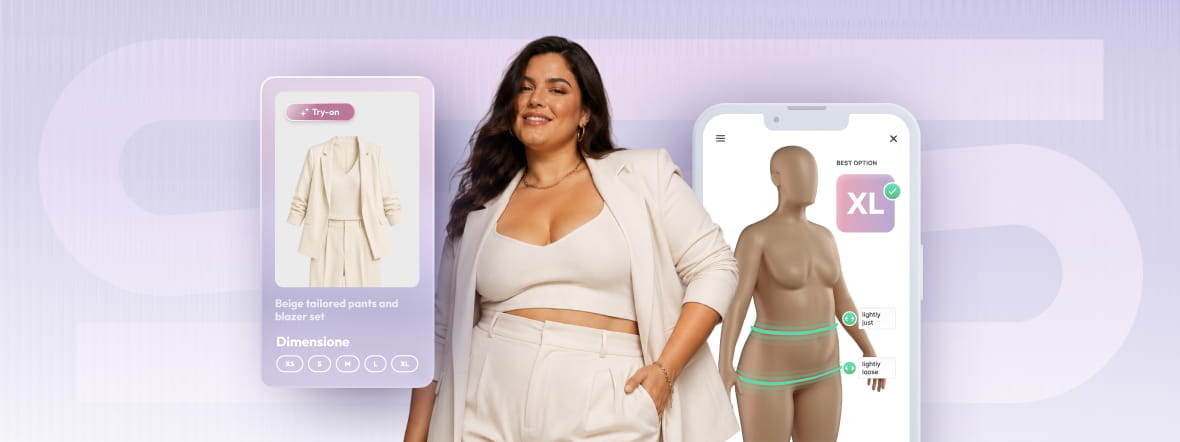
When shoppers enter height and weight into a standard virtual fitting room, they usually receive recommendations based on direct matches with size charts and body-type adjustments.
Although this approach works to some extent, it still ignores important factors such as body proportions, weight distribution, and how each garment was specifically designed.
For example, two shoppers with the exact same height and weight may have completely different body structures. One person may have a fuller bust and narrow waist, while another may have more evenly distributed proportions. Consequently, an average-based recommendation often fails at the individual level.
Because of this complexity, Sizebay developed technology specifically designed to go beyond static measurements.
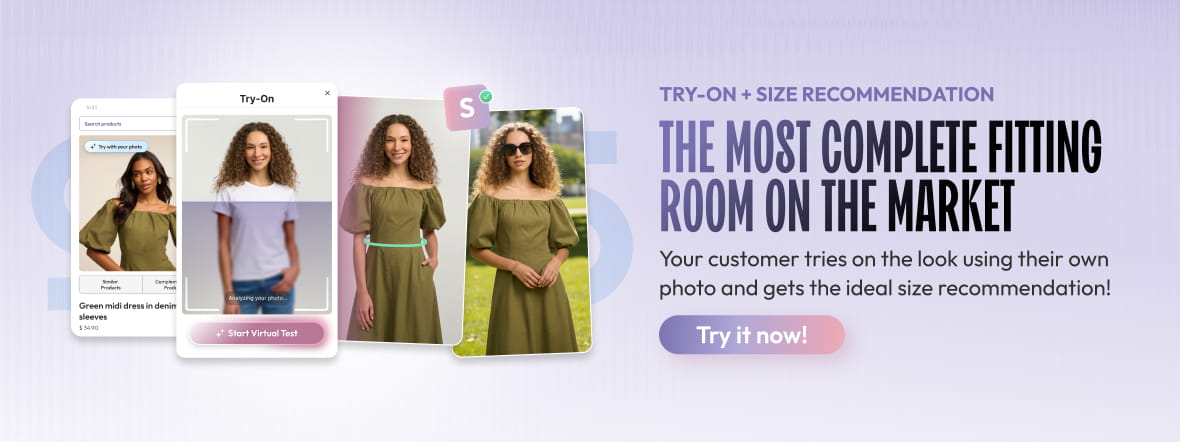
Instead of simplifying shoppers into averages, Sizebay’s virtual fitting room with Try-On technology combines anthropometric intelligence and AI trained on real data. As a result, shoppers can upload their own photo and virtually try garments on directly inside the ecommerce experience.
This advanced approach enables:
- Up to 5x increase in purchases
- More accurate size recommendations
- Up to 50% reduction in returns
Do virtual fitting room solutions understand different fashion categories?
Choosing a solution that understands the specific characteristics of each category is essential. Fortunately, some advanced providers are built with this complexity in mind.
For example:
- Kidswear has its own fit standards
- Lingerie sizing behaves differently from apparel
- Footwear requires different logic
- Plus-size products follow unique body proportions
Why lingerie sizing requires specialized technology
In lingerie, the difference becomes even more evident. Brands such as Intimissimi use underbust measurements in addition to bust measurements.
Because of that, recommendation accuracy can improve by up to 40%. Therefore, solutions that ignore these variables inevitably lose precision.
Sizebay addresses these challenges through category-specific modeling logic validated by in-house specialists in:
- Patternmaking
- Fashion design
- Fit analysis
- Garment construction
Rather than relying on generic templates, the platform adapts recommendations according to each category’s unique requirements.
Read also: Cart abandonment in an italian fashion e-commerce
How can a virtual fitting room maintain accuracy on a global scale?
To maintain accuracy, a virtual fitting room must be developed with multiple body types in mind, rather than functioning as a regional solution limited to static measurements such as height and weight.
If you operate in only one country with a single sizing system, this detail may seem minor. But if you operate internationally, this is exactly where many solutions begin to fail when they attempt to scale.
How can you tell if a virtual fitting room understands different body profiles?
Bodies vary not only between individuals, but also between regions. The average body profile in Brazil is different from Italy. Asian consumers have different body distributions. Women in LATAM markets have different proportions from those in European markets.
A solution built around a single average model may perform well in some regions and fail in others.
A solution designed for one specific context, such as the United States, will struggle when adapted to other markets. Not because the technology is bad, but because the problem was approached locally instead of globally.
Sizebay operates in +60 countries because it understands that body profiles vary geographically. This is not a decorative statement — it is proof that the technology was designed, built, and operated from the start by modeling specialists, fashion designers, UX designers, data analysts, and integration architects who understand this diversity.
Multiple sizing systems are not exceptions. They are the expected reality.
Is a virtual fitting room just a plugin or a complete infrastructure?
This is one of the questions that divides the market. And the answer determines the impact the solution will have on your operation.
What differentiates a sizing widget from a real platform?
A sizing widget is isolated and operates at only one point in the customer journey. It offers little or no connection to the rest of the operation — no product discovery integration, no data analysis, no evolution based on real feedback.
A true platform works as infrastructure, connecting multiple functionalities. Size recommendations feed the dynamic size guide, which feeds the shopping experience and data collection, ultimately generating business intelligence. Everything works together.
Sizebay does not operate as a standalone widget; our solution works as an integrated platform. Size & Fit (virtual fitting room + Try-On + dynamic size guide) connects with Fashion Hub (similar product recommendations, image search, AI-generated looks), which connects with Fashion Intelligence (structured real-time data).
Read also: Virtual Fitting Rooms in Fashion E-Commerce
How does the integration between recommendations, discovery, and data change results?
When you have an isolated recommendation, the impact is only the recommendation itself. But when you have a recommendation integrated with discovery, something changes. Consumers find their size, discover similar products, and explore complementary looks — all based on real intelligence about their body and preferences.
This can be seen in our Virtual Fitting Room with Try-On. With this solution, your customer defines their body measurements, receives the ideal size recommendation, and can also see themselves wearing the item they want.
This is possible thanks to the intelligence behind Try-On, which creates a realistic simulation of how the garment fits the customer’s body using the uploaded photo.
Can a virtual fitting room slow down a website or hurt performance?
This is a legitimate concern for any ecommerce operation. And the answer is: it depends on the solution you choose.
It is common for ecommerce managers to question whether implementing a virtual fitting room can increase loading times or negatively impact metrics such as Core Web Vitals.
The problem is that many market analyses reduce this discussion to the raw size of the transferred script. On its own, that does not represent the real impact of the technology on website performance.
When discussing loading performance, many variables are involved. That is why comparing only the initial size of a file is not enough to measure real impact on user experience or conversion.
There is another important point: not all solutions have the same level of functional complexity. Comparing a technology that delivers only one simple feature with another that supports multiple modules within the same architecture creates a distorted comparison.
Some platforms need to simultaneously support:
- virtual fitting room
- dynamic size guide
- try-on
- behavioral tracking
- event capture
- integrations
- data intelligence
In this scenario, analyzing only “script weight” without considering functional depth does not represent a fair comparison between equivalent solutions.
In practice, what determines impact is not only how many kilobytes exist in an application, but how the architecture was designed to operate.
So how do Sizebay solutions fit into this scenario?
Sizebay’s architecture was developed to support a complete ecosystem of functionalities within an optimized and scalable structure.
In addition to the Virtual Fitting Room, the platform integrates a Dynamic Size Chart, Try-On, event tracking, and data intelligence within the same technological foundation. This means performance analysis must consider the full context of the solution, not just the isolated size of a script.
Furthermore, the platform uses modern loading and execution strategies to minimize impact on user experience, maintaining smooth navigation and operational consistency even within more robust architectures.
Why is technology alone not enough in fashion?
The answer is simple: fashion is not just data — fashion is the interpretation of the human body. And that is something many tech products offering virtual fitting rooms for fashion ecommerce still fail to understand.
How do patternmaking specialists make a virtual fitting room more efficient?
A virtual fitting room backed by specialists in fashion and garment patternmaking can see beyond the garment itself. These professionals understand fit, measurements, fabrics, how each factor behaves on the body, and how that impacts wearability.
Anyone with machine learning knowledge can train a model that recommends sizes based on historical data.
Knowing this, Sizebay has an in-house team of fashion designers, pattern makers, and fashion specialists. Not external consultants — an internal team.
These professionals understand fashion. They validate size charts, identify when new collections require adjustments in recommendation logic, and suggest optimizations based on a real understanding of how garments behave.
How does this affect the continuous evolution of the solution?
When you implement a virtual fitting room backed by human expertise, you are not just implementing an algorithm. You are establishing a partnership with a team that understands fashion. A team that will suggest improvements, warn you when something may need adjustment, and validate new collections before they negatively impact recommendations.
This is not technical support. It is applied expertise.
It is the difference between a solution that works on day one and a solution that works better with every new collection and every stage of brand evolution.
How can you choose a virtual fitting room that is easy to use?

There is a common misconception that adding technology to ecommerce increases the chances of users abandoning purchases. Sometimes that is true, because the solution may be too complex or not user-friendly — but it should not be.
There are also important considerations, such as customization, that should be evaluated before deciding which solution to adopt.
How can a complex interface feel simple?
A good interface, no matter how complex it is behind the scenes, should always feel simple to the user because developers understand that usability is mandatory.
When a company prioritizes User Experience, consumers enter the ecommerce store, see a clean and intuitive interface, enter their measurements, and receive a clear recommendation. They understand the reasoning behind the suggestion and feel confident in what is being recommended.
Sizebay has been optimized for more than a decade to achieve exactly this. The platform has processed millions of recommendations and continuously tested experiences with real consumers.
The result is an interface that feels simple while delivering highly accurate recommendations.
Can a virtual fitting room be customized?
Yes, many solutions offer customization, but in different ways.
What does that mean?
Some options only allow changes to colors, logos, or text, making the solution look branded while consumers still recognize it as the same experience used by hundreds of other stores. Then there are true white-label solutions.
What differentiates a true white-label solution from cosmetic customization?
Cosmetic customization is superficial. Real customization goes further.
It means adapting the entire customer journey, flow, questions, recommendations, integration with your brand’s design system, and even creating unique experiences.
Sizebay offers complete white-label customization. You can customize colors, fonts, layouts, and the entire flow while maintaining integration with the core technology.
For brands with more advanced digital teams, we also offer a headless-ready architecture, allowing direct integration of our solutions into your frontend. This unlocks the ability to combine our capabilities with your own experiences — creating unique and advanced customer journeys.
Customize your virtual fitting room with SizeLabs
Inside Sizebay, there is an initiative called SizeLabs. This option works as pure co-creation.
Your team and specialists can work side by side with Sizebay experts to design an experience no one else has.
In this co-creation model, everything is designed to further improve the customer shopping experience, adapting every detail to provide more comfort and confidence.
This changes the value proposition entirely.
You are not simply using the best and most complete solution on the market. You are using the best solution customized specifically for your brand.
Read also: Why you need virtual Try-On if you sell sneakers
How does virtual fitting room data become business strategy?
This is where the solution stops being tactical (reducing returns) and becomes strategic (fueling business decisions).
An advanced virtual fitting room is structured to generate actionable insights, allowing segmentation by category, age, and location. This enables your team to identify patterns and make decisions based on real data rather than assumptions.
A basic virtual fitting room simply delivers recommendations. You have no visibility into which sizes are most recommended, return rates by size, or how your consumers’ body profiles are distributed.
Sizebay delivers this through Fashion Intelligence, a structure specifically developed for fashion ecommerce businesses operating strategically.
This functionality collects real-time data from every interaction, structures it into reports, enables deep analysis, and can integrate directly with your BI systems.
How do consumer body data influence purchasing and merchandising?
With this data, you can:
- Make smarter inventory purchasing decisions
- Identify SKUs with high return rates
- Create segmented campaigns
- Predict trends
- Stop making fashion decisions based on assumptions and start making them based on real data
- Create more targeted campaigns
- Deliver personalized offers
- Provide personalized product recommendations and much more
Everything is based on real data, not guesswork.
Will the virtual fitting room you choose scale with your business?
This is a question very few companies ask, but it should be central to the decision.
A solution that does not evolve alongside your brand is a solution destined to lose relevance. In addition to losing the initial investment, you will eventually need to go through the entire selection process again to find a new provider.
At Sizebay, we operate with the goal of helping your ecommerce grow. That is why the logic behind our solutions is based on continuous evolution.
We combine real-time data with specialized support so that as your brand grows, the solution grows with you.
Furthermore, Sizebay does not offer only a virtual fitting room. We offer an ecosystem that connects fit, discovery, and data. This expands the impact beyond recommendations, influencing the entire customer journey and helping build the future of fashion alongside your brand.
The question that should end your decision-making process
When evaluating a virtual fitting room, asking questions, and requesting demos, there is one final question that should define everything.
Does this provider understand fashion, or only technology?
The answer says everything.
A solution that understands fashion knows that bodies are complex, products are complex, and fashion exists in different contexts. A solution focused only on technology simplifies everything and delivers quick answers.
Sizebay is a platform built by people who truly understand fashion, offering the most complete virtual fitting room solution on the market.
We combine cutting-edge technology with deep fashion expertise. And we go even further.
Our operation works globally, with support teams available in every country where we operate. In addition, we continuously evolve alongside your business from the very beginning of the partnership, because we understand how essential it is to have a partner that wants to grow together with you.
Looking for a partner like this? Get in touch with us and speak with one of our specialists!
Read also: Virtual try-on for glasses: how it works and why eyewear retailers are adopting it