The World Cup is one of the most reliable demand spikes in sports retail.
From national jerseys and fan collections, to licensed training gear, shoppers arrive with high intent, clear motivation, and money to spend. For e-commerce teams, it’s a window for boosted sporting goods sales that comes around once every four years, and the pressure to capture it is real.
But the same conditions that drive sales also create a returns problem. Emotional purchases made in a hurry, gifts bought without certainty, shoppers who guess their size because they are too impatient to investigate all show up two to three weeks later as a returns wave that hits logistics teams long after the campaign budget has been celebrated.
If you are planning your World Cup push and have not thought seriously about your sizing experience, you are setting yourself up for a painful post-tournament correction.
Thinking about that, we develop this content. Here we’ll talk about what makes sports apparel sizing unique, the sell opportunity presented by the World Cup and what you can do to reduce returns in ecommerce.
Why Sports Apparel Sizing Is Uniquely Hard
Most shoppers carry a rough mental model of their size. It’s always a thought based on the commom sizes, like medium, large, 42. That model works reasonably well for everyday clothing, but it falls apart fast in sports apparel.
This happens because the category has its own sizing logic:
- Official fan jerseys often run large, designed to be worn loosely over other layers
- Performance and training pieces run slim, built around athletic body proportions
- Compression gear uses entirely different sizing systems based on body measurements
- Licensed products from different brands, even within the same retailer, can vary significantly in cut and fit
Let’s take a look at a shopper who wears a medium in everyday clothes. This person might need a large in a national team jersey and a small in a base layer.
That is an information the buyers almost certainly do not know and they are not going to read a size chart carefully enough to figure it out. Especially when they are buying in the moment.
How can you reduce consumer uncertainty about clothing sizes?
In these cases, using detailed product descriptions should be a standard practice. This solution will help you reduce returns in e-commerce, mainly in sportswear.
When applied correctly, clear information improves understanding. This includes fabric characteristics, garment construction, and how the piece fits on the body. All of this makes it easier for shoppers to evaluate the product before purchasing.
In addition, product descriptions can address the main questions and concerns raised by previous customers, becoming a valuable reference for new buyers. That’s why it’s important to keep your team attentive to comments on social media, communication channels such as chat and WhatsApp, and even reviews or comments on your website.
Related: 4 reasons why product descriptions are so important for online fashion
Why does the World Cup multiply the risk of exchanges and returns in e-commerce?

World Cup purchases are highly emotional and often driven by urgency. Because of that, shoppers are not casually browsing sportswear collections, they want their jersey delivered before a specific match, which means purchase decisions happen faster and with far less tolerance for uncertainty.
To comprehend better these risks, we brought the most frequent scenarios that a buyer can pass through while buying during this period.
Emotional decisions with urgency
When there is a real deadline involved, consumers are much more likely to guess their size instead of taking time to investigate fit details carefully. This behaviour is seen most times when the buyer needs the product for him to watch a match or to honor the team he is passionate about.
Another option is an urgency to have a limited edition of an item that wil soon be over. This situation makes the buyer choose whatever is de size he thinks is the correct one. But, when the product arrives, it’s notable that he picked the wrong number, color or model.
This behavior significantly increases the likelihood of exchanges and makes it harder to reduce returns in ecommerce during high-demand periods.
Gift purchases
Gift purchases also become much more common during major sporting events. In many cases, the buyer is choosing a jersey for someone else and has only a vague idea of that person’s body type or preferred fit.
That situation creates a large margin for sizing error. Especially in products like jerseys and performance apparel, where fit plays a major role in comfort and satisfaction.
For ecommerce managers trying to reduce returns in ecommerce, this creates an additional layer of complexity that standard size charts rarely solve effectively.
Group purchases
At the same time, group purchases amplify the operational challenge even further.
Families, friends, and fan groups frequently buy matching kits together. When that is the case, a single sizing mistake can create partial returns that complicate logistics and damage the customer experience.
Even if most of the order was correct, the frustration caused by one incorrect size often affects the perception of the entire purchase.
The situation becomes even more critical because popular national team jerseys and common sizes tend to sell out quickly during the tournament period. When shoppers realize they ordered the wrong size and try to exchange it, the size they actually need is often no longer available.
At that point, there is rarely a positive outcome for either the customer or the retailer. This is exactly why sizing confidence becomes essential for brands looking to reduce returns in ecommerce during high-traffic sports events like the World Cup.
World Cup-Specific Tactics to Reduce Returns

Fortunately, most sizing-related returns are preventable. They happen because shoppers are uncertain and the buying experience does not resolve that uncertainty before they make their purchase.
These are practical tactics you can put in place before the tournament starts.
Add a Size Confirmation Popup at Checkout
This is one of the simplest and highest-impact things you can do. Before a shopper completes their purchase, surface a prompt that reminds them: if this does not fit and needs to be returned, the replacement may not arrive in time for game day. Ask them to confirm their size choice before proceeding.
This does two things. It creates a moment of pause that catches impulse guesses before they become returns, and it frames the sizing decision in terms of the shopper’s own interest, not just a procedural step.
Shoppers who stop and reconsider their size at this point are much less likely to send the product back, helping your operation reduce returns in ecommerce.
Related: Optimizing Checkout in Fashion E-commerce
Implement a Virtual Fitting Room
Today, most ecommerce stores already offer size recommendation tools based on the shopper’s body measurements. For a long time, this has been considered one of the safest ways to improve sizing accuracy during the purchase journey.
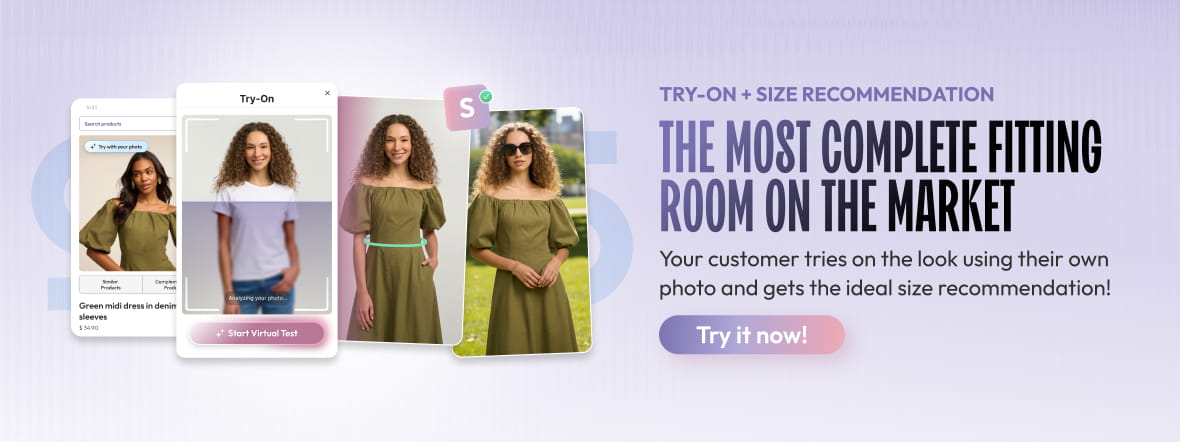
However, a virtual fitting room with Try-On technology takes this experience much further. It allows shoppers to upload a photo directly to the website and virtually “try on” the garment using artificial intelligence. The technology shows how the piece is expected to fit on their body based on the recommended size according to their measurements, age, height, and weight.
For fan merchandise and sports apparel, this visual confirmation makes a huge difference. Consumers are already imagining how they will wear that jersey: while watching a match with friends, posting photos on social media, or attending an event.
When shoppers can visualize the product on their own body, the gap between expectation and reality decreases significantly — and return rates tend to decrease as well.
In addition, a virtual fitting room helps reduce the common behavior of “buying two sizes and returning one,” which becomes especially frequent during high-demand periods.
This happens when shoppers feel confident both about the size recommendation and about how the garment looks before purchasing, they are far more likely to keep the product. And, of course, this instantly helps you reduce returns in ecommerce.
Related: Cutting-edge virtual fitting room technology: what to consider
Build a Gift-Buyer Sizing Flow
When someone is buying a jersey as a gift, they need a different experience than someone buying for themselves. Give them a way to input what they know about the recipient, whether that is rough measurements, height and weight, or just their typical size in a familiar brand, and surface a recommendation based on that input.
This small UX investment pays off significantly during a window when gift purchases spike. A shopper who receives a confident recommendation for their gift is far less likely to guess, and far less likely to return.
Prompt Sizing Checks on Multi-Item Cart Orders
When a shopper has multiple jerseys in their cart, surface a sizing prompt for each item individually before checkout. Do not assume that someone who got their own size right has also gotten the right size for every other person in the order.
A simple “have you confirmed the right size for each item?” prompt at cart review catches the errors that happen when someone is juggling multiple recipients and making quick decisions.
Use Delivery Deadlines to Drive Better Sizing Decisions
Combine urgency messaging with sizing nudges at the product page level. If you are already showing shoppers a delivery estimate tied to the next match, pair that with a size recommendation prompt. The logic is simple: you want this in time for the game, so make sure you are ordering the right size now, because there may not be time to exchange.
This turns deadline pressure, which usually makes shoppers guess faster, into a reason to get sizing right the first time.
Create a Visual Badge for Products With Unique Sizing or Fit
When your ecommerce store sells a large number of garments with unique fits or non-standard sizing, there is a simple solution that can help shoppers pay closer attention to sizing details before purchasing.
One effective approach is to create a visual badge directly on the product page highlighting whether the garment runs larger or smaller than usual. This immediately draws attention to important fit information while the shopper is viewing the product image.
This type of sizing badge becomes even more effective when combined with a virtual fitting room with Try-On technology. In this scenario, shoppers can test the product experience almost as if they were inside a physical fitting room, making it easier to understand which size works best for their body and helping reduce returns in ecommerce.
Ultimately, these solutions work best together. By combining fit communication, visual guidance, and personalized sizing technology, brands can significantly improve the customer experience while directly reducing operational losses caused by exchanges and returns.
Prepare Before the Traffic Arrives
Sizebay’s Try-On was specifically developed to solve one of the biggest challenges in online fashion sales: size uncertainty and the financial losses that come from it.
Instead of relying solely on size charts or customer guesswork, the technology allows shoppers to visualize how a garment is actually expected to fit on their own body before completing the purchase. This helps reduce returns by up to 50%, which remains one of the leading causes of exchanges in sportswear ecommerce.
By combining intelligent size recommendation with realistic garment visualization, Try-On transforms the purchase decision into a much safer and more predictable experience.
The result is greater shopping confidence, leading to a 12% increase in average order value and up to a 40% increase in repurchase rates and helping you to reduce returns in e-commerce at 50%.
Implement this solution now to reduce returns in sportswear ecommerce and achieve even higher profit margins during the World Cup season. Talk to one of our specialists today.
Related: How Vörr used Sizebay to lead on experience with try on.