
Sneakers are an interesting part of fashion because they mean different things to different people. To some, they’re a fashion statement, a status symbol; to others, a performance tool.
For many shoppers, buying a new pair of sneakers is an emotional decision. Style, comfort, and personal taste all factor into it. That’s why sneaker shoppers browse longer, compare more, and hesitate more than the average apparel customer. It’s also why footwear has become one of the toughest categories to sell online without giving something back in return costs.
As online shopping grows, this hesitation becomes even more visible. Without the ability to try, feel, or see sneakers on foot, consumers are left guessing. Will the silhouette look bulky? Will the colorway match my wardrobe? How will the shoe sit on my ankle? These are visual questions, and product photos alone rarely answer them well enough to close the sale.
Virtual try-on technology is addressing those questions. What started as a novelty feature has turned into a strategic tool used by brands, marketplaces, and fast-growing online stores. It responds to real shopper behavior, reduces decision friction, and builds confidence before checkout. Just as importantly, it connects the online journey more closely to the in-store experience, the one thing ecommerce has always struggled to replicate.
In this guide, we’ll look at what virtual try-on means for online sneaker retailers, how the technology actually works, what the return data says about the problem it solves, and why pairing try-on with real size recommendation is quickly becoming the standard for reducing returns and increasing conversion.
What the Data Tells Us About Sizing and Returns
Before getting into the technology, let’s talk about the scale of the problem, because the numbers are bigger than most retailers assume.
Footwear consistently ranks among the highest-returning categories in e-commerce, with subcategory return rates for shoes reported as high as 31.4%, ahead of most other apparel segments. Across fashion broadly, sizing and fit issues are cited as the cause behind roughly half of all returns, and separate industry data puts “sizing, fit, and color” together as the driver of close to 45% of returns storewide. This is the single biggest reason fashion e-commerce loses money on orders it already won.
The pattern behind those numbers is familiar to anyone running a footwear store. Shoppers order two sizes with the intent of returning one, a habit known as bracketing. Others order based on a size chart, get the shoe, and find it runs narrow, or the toe box fits differently than expected. And a large share of returns come down to a simpler issue: the product looked different once it arrived. Shopper research on apparel returns backs this up directly, with a large majority (93%) of shoppers saying product photos matter more than almost anything else in the decision, and roughly half admitting that items have looked different in person than they did online.
That tells us that sneaker returns aren’t mostly a manufacturing or shipping problem. They’re a confidence problem, and confidence problems have a technology answer. To that end, virtual try-on and size recommendation tools are the most effective solution to reduce sneaker returns.
Is there real data proving virtual fitting rooms reduce returns?
Yes. Our internal data from retailers using our size recommendation solutions have reported up to 50% fewer returns, alongside a 12% lift in average order value and repurchase rates running 40% higher among shoppers who used the tools before buying.
What is Virtual Try-On for Sneakers?
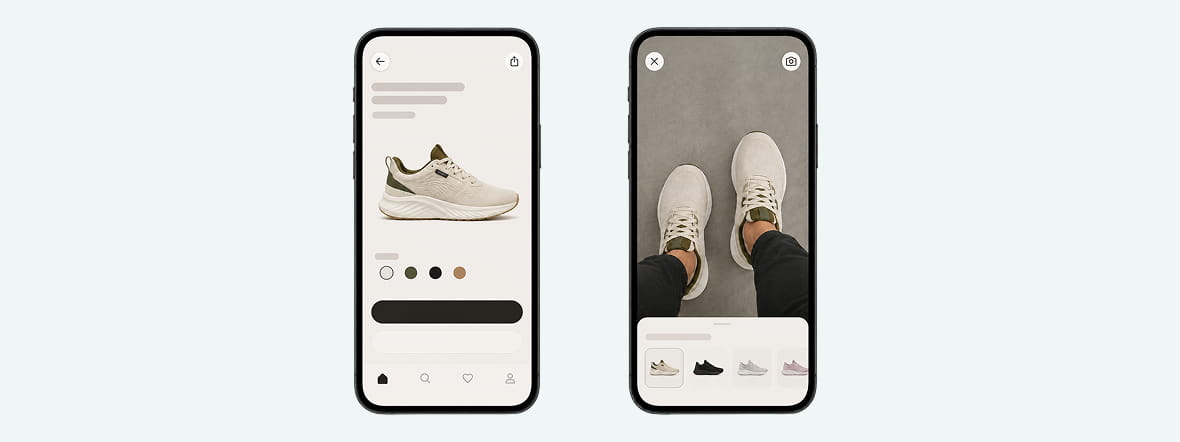
Virtual try-on for sneakers is a smartphone-powered technology that uses augmented reality (AR) to place a digital sneaker model directly on a shopper’s feet.
It’s a simple idea that takes the familiar moment of slipping on a shoe in a store and translates it into a fast, intuitive, camera-based experience online. Even though the technology running on the backend is complex, the result feels immediate and natural. Shoppers point their phone at their feet, choose a model, and see how the shoe looks from different angles as they move.
Does virtual try-on work for any brand or model of sneakers?
Not automatically. Virtual try-on relies on a 3D model of each specific shoe, so coverage depends on how many SKUs a retailer or platform has digitized. Most modern solutions, including Sizebay’s, are built to onboard new models efficiently, which is why the retailers seeing the most value tend to prioritize their best-selling styles and drops first, then expand coverage across the catalog over time.
How does Virtual Try-On for Sneakers Work?
Under the hood, AR try-on uses the user’s smartphone camera feed and motion sensors to detect their feet and anchor a 3D model in real time. The system calculates angle, position, and depth, then renders the shoe so it appears naturally aligned with the foot. The customer sees their real feet with a virtual sneaker placed on top.
There are typically three components:
- A 3D model of the sneaker.
- A computer vision system that identifies the shopper’s feet.
- A rendering engine that adjusts lighting and angle to place the shoe accurately.
But AR has limits. It shows how a sneaker looks, not how it feels. Even Amazon notes that virtual try-on is for visualization, not for determining true fit or comfort.
This limitation opens an important strategic opportunity for footwear retailers. Use virtual try-on strengthens visual confidence, and pair it with a size recommendation tool to strengthen functional confidence. Customers solve both concerns at once. The result is a smoother journey and fewer returns.
Read More: How Virtual Try-On Technology Works in Fashion E-Commerce
Virtual Try-On Variants
There are additional forms of virtual try-on beyond smartphone overlays. Some retailers use AR smart mirrors in stores so customers can cycle through models without physically putting on each pair. Luxury brands like Gucci have explored these immersive installations.
Others offer static photo-based try-on, where shoppers upload an image and place shoes digitally. This approach works better for apparel, since sneaker shoppers expect real-time movement and angle accuracy.
Across all variants, real-time AR has become the dominant technology for sneakers because it aligns best with how sneaker enthusiasts evaluate style.
The technology continues to advance. More accurate foot tracking, smarter 3D modeling, AI-driven lighting adjustments, and emerging fit-personalization algorithms are shaping the next generation of virtual try-on. But for now, AR-driven try-on and interactive 3D viewing represent the most mature and effective solutions available to sneaker retailers.
Why Virtual Try-On Is Especially Impactful for Sneakers
Sneakers are one of the most visually sensitive categories in fashion. A small change in the midsole, toe shape, or collar height can completely alter how a shoe looks on someone’s feet. Shoppers want to know not only whether they like a model, but whether they like it on themselves, and that’s something product photos rarely answer.
Virtual try-on addresses that. By placing the sneaker directly on the shopper’s feet through their phone, it removes guesswork and gives a true sense of silhouette, proportions, and color. That matters a lot in a category where returns often happen because the shoe “looked different in person.”
Sneaker culture also moves fast. Drops sell out quickly, trends shift overnight, and shoppers make decisions visually and under time pressure. A quick AR preview fits naturally into that behavior and encourages exploration across models and colorways rather than a single, cautious purchase.
Put together, this is why sneakers sit in the category where virtual try-on delivers the clearest and most immediate impact. The more appearance decides the purchase, the more valuable virtual try-on becomes..
Try-On vs. the Full Virtual Fitting Room: What’s the Difference?
This is one of the most common points of confusion for retailers evaluating the technology.
Try-On is the visualization layer. It’s the AR experience that lets a shopper see a specific sneaker on their own feet before buying. On its own, it answers the appearance question: does this shoe look right on me, in this colorway, at this angle. It’s fast to activate, works product by product, and is often the entry point stores use to start solving the “looked different than expected” return reason.
A virtual fitting room is the broader system that Try-On sits inside. It combines that visualization layer with size recommendation, using a shopper’s measurements, fit preferences, and behavioral data to answer the second, and arguably harder, question: what size should I actually order. Where Try-On solves how the shoe looks, the size recommendation engine solves how it fits, and the fitting room is what brings both answers into the same product page experience.
What’s the difference between a virtual fitting room with size recommendation and the Try-On feature?
Try-On is a visualization tool. It shows a shopper what a sneaker looks like on their feet. A virtual fitting room, like Sizebay’s, is the complete system: it uses Try-On for visualization and pairs it with a size recommendation engine so shoppers get both a visual and a functional answer in one flow. Retailers can start with Try-On alone, but the return-rate impact grows meaningfully once size recommendation is added, since visual confidence and sizing confidence solve two different problems.
Where Virtual Try-On Pays Off
Not all categories benefit equally from virtual try-on. Sneakers sit in the sweet spot where the technology aligns perfectly with shopper needs. This is reflected in measurable results across brands and retailers.
The first major benefit is improved conversions. When customers visualize sneakers on their feet, they hesitate less. The number of product-page interactions increases. The time spent exploring variations increases. Most, importantly, the probability of pressing “add to cart” increases.
The second benefit is reduced return rates. Many returns in footwear are driven by color expectations, silhouette confusion, and stylistic mismatch. While, Virtual try-on does not guarantee perfect fit, it prevents the most common return reason in fashion ecommerce: “It did not look like I expected.” When that gap disappears, stores save money.
The third benefit is stronger discovery. Shoppers who test one model often explore others. They switch between colorways or browse similar silhouettes. This increases exposure to more SKUs and supports long-tail inventory.
The fourth benefit is stronger brand engagement. When customers share screenshots or videos of virtual try-ons, they generate organic visibility. This is especially valuable in sneaker communities where personal style and peer influence drive interest.
Together, these outcomes make virtual try-on for sneakers a commercial tool that influences both the top and bottom of the funnel.
Virtual Try-On Works Best When Combined with Size Recommendation
Virtual try-on solves the appearance problem. Footwear size recommendation solves the fit problem. Together, they create a complete solution to overcome uncertainty in footwear shopping.
When a shopper tries a sneaker virtually, they see how it looks, but they still have to decide what size to order. When the system also recommends the right fit based on their profile, both questions get answered in the same flow, and that’s where confidence really compounds. Shoppers stop guessing and start buying with a decision they trust.
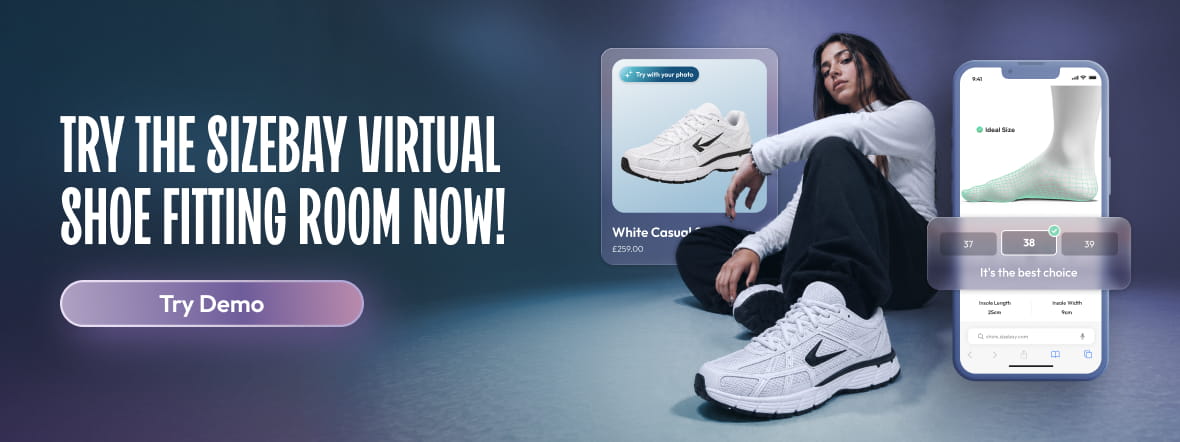
Many stores still treat virtual try-on as a standalone feature, and that’s usually where the returns plateau. The real value shows up once try-on becomes part of a broader personalization system rather than an isolated widget. This is where Sizebay’s approach differs: by connecting sizing data, fitting models, anthropometric insights, and shopper behavior into one experience, stores give shoppers a single, intuitive path from browsing to checkout, instead of two disconnected tools solving half the problem each.
This is the direction online footwear is heading. Not just seeing the shoe, but knowing, with real confidence, that it fits.
What It Costs to Implement a Virtual Fitting Room
Implementation cost depends on scale: how many SKUs need 3D models, how much traffic the store handles, and whether the retailer wants Try-On alone or the full fitting room with size recommendation included. Sizebay structures its plans around that reality rather than a single flat price, so smaller stores aren’t paying for infrastructure built for enterprise catalogs, and larger retailers get a plan that scales with their SKU count and traffic.
The Try-On feature specifically runs on a credit-based model, so cost tracks directly with usage rather than a fixed monthly guess. Stores pay for the try-on sessions shoppers actually generate, which makes it easier to test the feature on a portion of the catalog, measure the return-rate impact directly, and scale up once the results are clear.
How much does it cost to implement a virtual fitting room in an online store?
It depends on catalog size, traffic, and whether a retailer wants Try-On alone or the full fitting room with size recommendation. Sizebay offers plans built around those variables rather than one-size-fits-all pricing, and the Try-On feature specifically operates on credits, so retailers pay in line with actual usage instead of committing to a flat cost upfront.
The Future of Sneaker Virtual Try-On
Sneaker shoppers rely heavily on appearance, style, and emotional connection. Virtual try-on technology responds to these behaviors by giving them a clear and intuitive way to visualize their choices. For e-commerce stores, this translates into higher confidence, higher conversion, and fewer returns.
As the technology becomes more accessible, stores of all sizes can adopt it without complex development or costly infrastructure. But the real opportunity lies in integrating virtual try-on with advanced size and fit recommendations. Appearance plus accuracy creates a complete solution that solves two of the biggest issues in online footwear shopping.
If you’re interested in learning about how our virtual try-on solutions could improve your e-commerce performance, schedule a demo today!