Flash sales still sell fashion. They can reduce price resistance, create urgency and generate a rapid spike in demand, especially during major promotional periods. But a flash sale only solves one part of the purchase decision: price.
It does not tell shoppers whether the product is right for them, how it will look on them or which size they should choose. And when those questions remain unanswered, more promotional orders can also mean more returns, higher costs and less retained revenue.
So the real question is not whether flash sales work. It is what happens after the discount does its job.
Are Fashion Shoppers More Price-Sensitive Than Before?
Yes, but price sensitivity is becoming more strategic.
Fashion and apparel are among the categories where discounts have a particularly strong influence on purchase decisions. In the UK, more than 70% of purchase decisions for appliances and apparel were reported as discount-driven, while in Italy, up to 78% of purchase decisions were influenced by discounts. The same Italian research found that between 47% and 74% of shoppers would switch brands for a better offer.
At the same time, shoppers are becoming accustomed to waiting for promotions. According to RetailNext’s 2026 Shopper Sentiment Report, based on a survey of 1,053 US consumers, 37.7% say they buy mostly during major promotions. The same report found that 33.9% say unfair or unpredictable pricing would make them stop shopping with a retailer altogether, ranking it above poor product quality and bad service.
This creates an important distinction. So price sensitivity is real, but it’s more thoughtful than simply buying whatever’s on sale. McKinsey and BoF’s State of Fashion 2026 notes that shoppers are rethinking how they spend and looking for value. Price matters, but it’s being judged alongside quality and experience.
For fashion retailers, that means a flash sale can make a product more attractive, but it cannot make a confusing product page clearer or an uncertain fit more predictable.
Why Do Fashion Brands Still Use Discounts?
Used strategically, promotions solve real commercial problems.
But, for most fashion operators, the objective is not simply to sell something for less. A promotion usually has a specific job to do:
| Promotion goal | What the discount can help solve |
| Acquisition | Lower the barrier for a first purchase |
| Inventory turnover | Move aged stock before it loses more value |
| Seasonal sell-through | Clear previous collections for new arrivals |
| Demand recovery | Restart sales in a slow category or period |
| Major retail events | Compete during moments such as Black Friday |
On the other hand, a flash sale can be particularly useful when the retailer needs to concentrate demand into a short window. For example, a clearance event for last season’s outerwear can help convert ageing inventory into cash while making room for a new collection. The limited duration adds urgency to a discount that might otherwise have less impact.
In that situation, the promotion has a clear purpose.
But, the problem starts when a discount is expected to solve something that price cannot actually fix.
For example, if shoppers are abandoning the purchase because they do not understand the fit, reducing the price does not remove that uncertainty. Also, if customers are returning because the size is wrong, a larger discount does not make the garment fit better.
That is where promotional strategy starts becoming a profitability issue rather than simply a sales strategy.
Can Too Many Flash Sales Hurt a Fashion Brand?
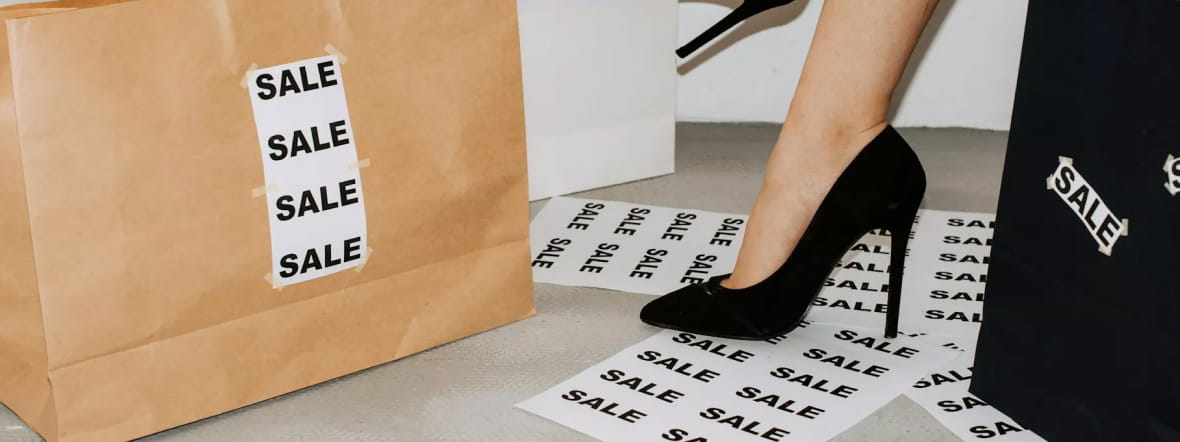
They can, especially when promotions stop being occasional and become routine.
When discounts become the default response to slowing sales, a familiar cycle can emerge: sales flatten out, the team launches a promotion, and orders recover for a while. But once that lift fades and sales begin to slow again, another promotion is needed, often with an even deeper discount to generate the same response.
Over time, this can turn promotions from a targeted commercial tool into an expected part of the customer journey. RetailNext’s 2026 Shopper Sentiment Report warns about exactly this effect: promotional calendars shape how customers shop, and the more a retailer depends on discount events to drive volume, the more shoppers hold off until the next one.
However, the bigger problem may be what the discount is hiding.
When sales stall, price is not always the underlying issue. It may be product quality, inaccurate product information, inconsistent sizing, or a product page that leaves basic fit questions unanswered. A lower price can make the first purchase easier despite those problems, but it does not fix them.
And if that first purchase comes back because the item does not fit, the discount did not create a retained customer. It created a return.
Do Flash Sales Increase Return Rates in Fashion?
They can, particularly when promotions bring more first-time buyers, encourage shoppers to try unfamiliar categories, or make ordering multiple sizes feel like a low-risk decision.
That does not mean every flash sale automatically causes more returns. Rather, promotional periods can create conditions in which fit uncertainty becomes more consequential because more shoppers are making purchase decisions quickly and at higher volumes.
This matters particularly in apparel.
The National Retail Federation and Happy Returns estimated that 19.3% of US online purchases were returned in 2025. Separately, Coresight Research found a 24.4% online return rate for US apparel, with size and fit identified by 53% of apparel sellers as the top reason for returns.
The problem extends beyond sizing alone. Akeneo’s 2025 Consumer Returns Report found that 43% of consumers had returned a product in the previous year because pre-purchase information was incorrect. Clothing was the category shoppers were most likely to return, while sizing was the most frequently cited issue, reported by 58% of consumers.
Taken together, these figures point to a broader issue: the faster a promotion creates demand, the more important it becomes to make sure shoppers have enough information to make the right purchase.
How Much Can Returns Cost a Flash Sale?
This is where the economics of a promotion become clearer.
Imagine a brand sells 1,000 units of a $100 product at 30% off. If each unit costs $45, each completed sale generates $25 in gross margin, producing $25,000 for the campaign before returns and return-related costs.
Now use a 25% return rate for illustration, roughly in line with the 24.4% US online apparel benchmark cited above. That means 250 units are returned, removing $6,250 in product margin.
If the brand then spends an additional $15 per return on shipping, handling and processing, that adds another $3,750 in costs.
The result is approximately $15,000 in remaining margin, a 40% reduction from the original $25,000, before accounting for damaged items, markdowns or inventory that becomes harder to resell.
The lesson is not that promotions are unprofitable. It is that revenue generated at checkout is not the same as profit retained after the return window closes.
Once returns enter the equation, the question changes from “How many orders did the flash sale generate?” to “How much value did those orders actually retain?”
Related: Size Uncertainty: What It’s Really Costing Your Fashion Store
What Do Fashion Shoppers Need Before Checkout?
To answer that question, it helps to look at what the shopper is actually trying to resolve before buying. At a minimum, they need to understand:
- What exactly is this product?
- How will it look on me?
- Which size should I choose?
A discount answers none of these questions. A shopper can be certain about the price and still uncertain about the purchase. During a flash sale, that gap becomes even more relevant, because the promotional mechanic is designed to shorten the time between consideration and checkout.
It also affects the shoppers who need the most help. A first-time customer needs to understand how the brand fits. A shopper trying a new category needs more information about the product. Someone considering two sizes needs a reason to believe one will be right. If the product page cannot provide those answers, the promotion may simply help shoppers make faster guesses.
The answer, therefore, is not to stop discounting. Instead, retailers can make the purchase decision more informative at the exact moment promotional traffic reaches the product page, across three areas.
1. Product information
Clear descriptions, accurate fabric and fit details, model information and relevant imagery help shoppers understand what they are actually buying.
This becomes especially important because, as the Akeneo data above shows, incorrect or incomplete pre-purchase information can contribute directly to returns.
2. Visual confidence
Product photography helps answer what the item looks like, but shoppers may still wonder how that product will translate to their own body. That is particularly relevant when buying unfamiliar silhouettes, categories or products with a distinctive fit.
For retailers that use visual experimentation, Sizebay’s Try-On allows shoppers to visualize how a product can look on them before they buy.
3. Size confidence
This is where fashion e-commerce still has a fundamental limitation.
A shopper cannot physically try the garment before buying it. A generic size chart can provide measurements, but it does not necessarily tell an individual shopper which size is most appropriate for their body and that specific product. As a result, the shopper is often left to interpret the information and make the final decision alone.
Sizebay addresses this part of the journey with personalized size recommendation. The technology combines shopper data with the brand’s product measurements to recommend a size for each individual product, turning a sizing question into a more confident purchase decision.
The two experiences address different uncertainties: size recommendation helps answer “Will this fit?” while visual experimentation helps answer “How will this look on me?”
Related: Virtual Fitting Rooms in Fashion E-Commerce
Can Size Recommendation Improve Performance?
This is where personalized size guidance becomes particularly relevant.
A size recommendation tool can use a shopper’s body information and the product’s sizing data to recommend the most appropriate size for that specific product. Instead of asking the shopper to compare their measurements with a generic chart and make the final interpretation alone, the experience provides a personalized recommendation at the point of decision.
The potential commercial impact can be seen in cases such as METRO BRAZIL.
METRO BRAZIL Case: More Than 10x Higher Conversion
This shapewear specialist began using Sizebay’s virtual fitting room in 2026 after identifying sizing as one of the main causes of exchanges and returns. The brand found that its static size charts were not enough to guide customers through the sizing decision.
After implementation, sessions in which shoppers used the Sizebay tool converted at more than 10x the rate of sessions without tool usage. The case therefore provides a concrete example of how resolving sizing uncertainty can coincide with a significant difference in conversion.
Osklen Case: Higher Average Order Value and Months Without Returns
The impact is not limited to conversion. Osklen, for example, also saw a clear difference in the value and outcome of orders that went through the virtual fitting room. After implementing Sizebay’s Size & Fit, the brand recorded an 18.9% increase in average order value and a 27.4% increase in items per order for orders that used the tool.
Most notably for the returns discussion, for three consecutive months, Osklen had no returns among orders that went through the virtual fitting room.
What the Two Cases Show
Together, the two cases illustrate different parts of the same problem. At METRO BRAZIL, personalized size guidance was associated with a more than 10x higher conversion rate in sessions where the tool was used. At Osklen, orders using the tool were associated with higher average order value, more items per order and three consecutive months without returns among those orders.
These are case-specific results, not universal benchmarks. Performance will vary according to the retailer, category, implementation and shopper behaviour. However, both cases point to the same opportunity: when sizing is a meaningful source of purchase uncertainty, helping shoppers make a more confident decision can affect what happens both before and after checkout.
Across Sizebay’s customer base, the company reports, on average, up to 50% fewer returns, 5x higher conversion and 40% repeat purchase. These figures represent broader customer results and should not be interpreted as the specific outcomes of the METRO BRAZIL or Osklen cases.
Read also: How to Reduce Returns and Exchanges in Apparel E-commerce
More Orders Don’t Always Mean More Profit
This is why the most useful promotion dashboard is not necessarily the one showing the highest number of orders.
A fashion e-commerce manager should look at what happens after the transaction as well.
| Metric | What it tells you |
|---|---|
| Conversion rate | Whether the promotion is generating purchases |
| Revenue | How much sales volume the campaign creates |
| AOV | Whether shoppers are spending more per order |
| Return rate | How much of that demand is coming back |
| Return rate on promotional orders | Whether discounted orders behave differently |
| Return reason by SKU/category | Where sizing, fit or product expectations are creating problems |
| Margin after returns | How much profitability the campaign actually retains |
| Repeat purchase rate | Whether promotional buyers become returning customers |
These metrics connect the front end of the campaign with what happens afterward.
For example, if promotional conversion rises but return rates rise disproportionately, the additional orders may not create the level of retained revenue the dashboard initially suggests.
On the other hand, when shoppers understand the product and feel confident about the size, the promotion has a better chance of generating an order that stays sold.
Read also: Sales Strategies to Boost Your Fashion E-Commerce
So, Should Fashion Brands Keep Running Flash Sales?

Yes. The case for flash sales is not disappearing.
Promotions can create urgency, move inventory and generate demand quickly. The problem is what happens when that demand reaches a shopping experience that still leaves important questions unanswered.
The price may get shoppers to consider buying. But if they cannot understand the product, visualize it on themselves or confidently choose a size, the promotion cannot remove the uncertainty that remains.
That is why fashion brands should evaluate flash sales on more than orders, revenue and conversion.
The stronger question is whether the demand generated by a promotion turns into profitable orders, fewer avoidable returns and customers who are confident enough to come back.
Flash sales are designed to create urgency. The shopping experience needs to create confidence. When both work together, a discount can do more than generate another order, it can bring a shopper into the brand with a purchase they actually want to keep.
Read also: How to Sell Clothes Online: Increase Sales Without Increasing Ad Spend