QUICK ANSWER
To win Black Friday without losing margin, a fashion e-commerce store needs three things in place before the sale starts: a deliberate discount strategy instead of a blanket markdown, logistics and UX that can absorb peak traffic without errors, and sizing tools that answer “will this fit me?” before the shopper adds it to cart. Everything below breaks down how to get each piece right.
Black Friday is the biggest shopping event of the year for e-commerce, and for online fashion retailers it is both a growth opportunity and a stress test. Shoppers are more selective than ever, so the season has to deliver sustainable results rather than eroding margin in exchange for a one-time spike in orders.
This guide walks through what makes fashion Black Friday harder than most categories, where margin quietly disappears, what to fix before the sale goes live, and where technology can close the gap that operations alone can’t.
Why Fashion Faces Unique Black Friday Challenges
Fashion is consistently one of the top Black Friday categories worldwide, alongside electronics, toys, and home goods. Even so, it runs into bottlenecks that other categories don’t.
High return rates driven by sizing issues eat into margin and chip away at customer trust. Logistics networks feel that same pressure, since delivery times already stretch during peak volume even without the added complexity of size-driven returns.
On top of that, margins are already thin because retailers compete aggressively on price, and inventory mismanagement can just as easily turn into canceled orders as it can into excess stock nobody wants in January.
Shopper skepticism compounds all of it. About 51% of shoppers do not fully trust Black Friday or Cyber Monday discounts, which makes transparent, defensible pricing a competitive advantage rather than a nice-to-have. Free shipping remains just as decisive, influencing roughly half of all buyers, with an average threshold around $40 to unlock it.
With those pressures in view, it helps to see exactly how thin a typical Black Friday sale really is before deciding where to cut.
What Eats Your Margin on Black Friday
Say a t-shirt sells for $100 and costs $32 to produce. Selling it through a marketplace adds a commission on top, so for this example, assume the sale happens on the brand’s own site instead. That leaves a gross margin of $68, which looks healthy, until it has to absorb everything else the business runs on.
That $68 still has to cover fixed costs like salaries, owner pay, and rent on an office or warehouse, plus variable costs like shipping, taxes, the ad spend that brought the shopper in, and utilities.
Once those numbers are run, the room for error turns out to be narrow, especially for mistakes that add new costs on top of the ones already budgeted for. Three of those mistakes show up every Black Friday.
Bracketing, the Margin Killer Nobody Budgets For
To win market share, major retailers across the US and Europe made free, easy shipping the norm. Many fashion brands have since capped when free shipping applies, but in plenty of markets the open-ended version is still standard. And this is causing real pain for fashion e-commerce specifically.
That pain shows up as size bracketing: a shopper orders several sizes of the same item, tries them on at home, and sends back everything that doesn’t fit. Every round trip chips away at margin, and a lot of those returns never even make it back onto the shelf. Large retailers like Amazon route much of their returned stock straight to third-party liquidators, so the items often don’t return to the original seller at all.
Fulfillment Errors Under Peak Volume
Bracketing is a customer behavior, but the next margin killer starts inside the operation itself.
Picture Black Friday order volume hitting a team that isn’t staffed or set up to absorb it without dropping quality. This period leads to swapped shipping labels, the wrong item in the box, orders that don’t match what was placed.
Errors like these get expensive fast. This is because the reverse logistics needed to fix them can cost more than the product earned in the first place. At that point, the store ends up paying to sell and creating a bad first impression with new customers in the process.
Returns and Exchanges Because of Fit and Sizing
The third case is the one most specific to fashion. Shoppers ordering the wrong size is one of the top reasons for returns and exchanges in fashion e-commerce, followed closely by products not matching what the shopper expected when it arrived.
Each exchange costs twice over: reverse logistics to bring the wrong item back, plus outbound shipping to send the right size out. On a discounted order, that can wipe out the margin entirely. A straight return, by comparison, only costs once. But unlike a fulfillment error, there’s no operational fix for it after the fact, since the shopper made the wrong call at the moment of purchase.
Related: 5 Profit Margin Killers in Fashion E-commerce (And How to Fix Them)
How to Protect Your Margins Before Black Friday Starts

With the main profit killers mapped out, the next step is making sure the store is actually set up to avoid them.
Decide What to Discount, and What Not To
Shoppers show up expecting prices to drop, and they will, but the real question is where.
A blanket discount across the whole catalog is the fastest way to give back the margin just calculated above, so the offer needs to be a set of deliberate choices instead of a flat percentage. The table below breaks down how to split the catalog into three tiers.
| Tier | What Goes Here | Discount Depth | Goal |
| Hero styles | The pieces shoppers have been watching since before the sale, your traffic drivers | Deep | Pull shoppers through the door and into the funnel |
| Core products | Basics and best sellers you’ll still sell at full price later | Light or none | Protect margin on items that don’t need a push |
| Dead stock | Broken size runs, last-season colorways, styles that never found an audience | Steepest | Free up warehouse space; any recovery beats holding cost |
Multi-brand retailers can use this same tiering to negotiate with suppliers on volume or exclusivity for hero styles, since that’s where the margin to fund a real discount comes from in the first place.
Whichever way the catalog gets split, checking the size curve before committing to quantities matters just as much as the discount itself. Pulling last year’s sales by category and by size, then buying or allocating accordingly, avoids selling out of a medium on day one, which pushes shoppers into ordering a small or a large “to see,” and that lands right back in the returns pile.
Once the offer is locked in, the next promise being made to the shopper is delivery.And few things frustrate a buyer more than waiting on a late order.
Offer Express Logistics Options
Online shoppers consistently favor fast delivery, so giving them a choice of speeds and price tiers at checkout pays off. Working with carriers to define regions where orders arrive in two days or less, for example, and calling that out during Black Friday, adds real, visible value. That means negotiating across the whole chain, from long-haul carriers to whoever handles the last mile.
With the offer and delivery both in place, the remaining question is whether the store itself can handle the traffic and actually convert it into orders.
Audit (and Fix) the User Experience
A great shopping experience matters year-round, but it matters more during Black Friday, since every store is competing for the same distracted attention. For fashion e-commerce, that audit should cover a few specific areas:
- Platform: Does it offer the customization needed across categories, and support that responds fast when technical or commercial issues come up?
- Product Photos: Shoppers aren’t only comparing prices, they want to see how a product looks in real life, on real people, which is exactly what professional photography delivers.
- Optimize Checkout: Make it easy to buy quickly, since every other brand running a sale is chasing the same shopper.
- Mobile Experience: Most of the shopping journey happens on a phone, and mobile conversion rates still haven’t kept pace with how central the device has become — so mobile UX deserves ongoing, dedicated attention.
- Paid Traffic: The experience has to hold up before people even reach the site, which means checking that paid budget is pointed at products actually in stock rather than sold-out listings.
- Customer Support: Scale support up so the traffic and awareness already built don’t go to waste on unanswered questions, with processes that let agents solve problems fast without escalating.
Also read: How to Improve Your Online Fashion Store’s Customer Experience
Answer the Big Questions Before Shoppers Ask Them

During Black Friday, shoppers bounce between dozens of stores and offers, and every visitor arrives with a full energy bar that drains as they browse. The longer a session runs without a decision, the lower that bar gets. Eventually, the shopper jumps to another site or clicks the next sponsored banner.
Any unanswered question or lingering doubt drains that bar faster and sends the shopper to a competitor. Making sure the questions people always ask when buying clothes online are answered directly on the product page is one of the highest-leverage fixes available.
Will This Garment Fit Me?
Not knowing whether a garment will fit is one of the biggest obstacles in fashion e-commerce, and a size chart alone doesn’t solve it.
Charts are often confusing and hard to translate into a real body.
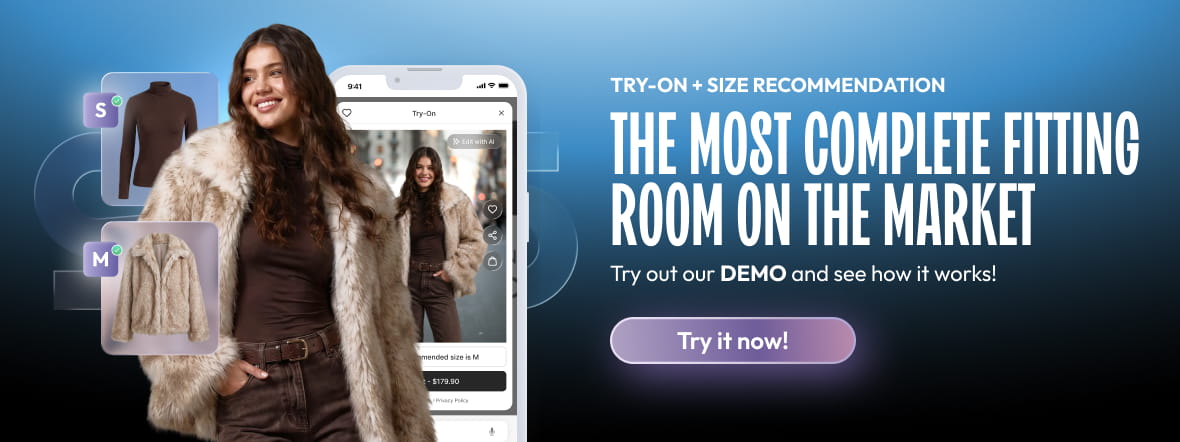
This is where Virtual fitting rooms and size recommendation tools come in. They are built to complement a well-built size chart, helping shoppers pick the right size with more confidence, which lifts conversion right at the point where the store has already paid to get the shopper to checkout.
Related: Virtual Fitting Rooms in Fashion E-Commerce
What Am I Actually Buying?
Fit is the biggest doubt, but it isn’t the only one. When product descriptions and photos are thin or generic, the shopper is effectively being asked to decide whether they like the item after it’s already been bought and delivered.
It’s not hard to see what that does to return rates.
What Do Other Buyers Say?
Feedback from people who already own the product can tip a hesitant shopper into buying. Stores that don’t have product reviews live yet should treat this as one of the first gaps to close before the sale.
Use Available Data to Generate Demand for Black Friday
Protecting margin is one side of the plan; making sure the right people show up is the other. Every store already holds audience data that can be used to put the right offers in front of people who already know the brand.
Most stores have two core sources of audience data: browsing data from site sessions, and purchase data, which tends to be the richest for targeting.
Building audiences around those behaviors works well. For example, think of people who browsed men’s versus women’s, or a specific collection with its own URL. From there, pair that with an email list segmented by recent purchasers, kept warm with regular touchpoints.
Social engagement is a third source, and one of the richest when a brand publishes good content consistently, since it lets the store target people who’ve recently engaged with the brand with real precision.
Follow Up After the Sale to Keep Customers
The same data keeps working after the sale closes. Adapting existing email and messaging flows into a dedicated post-Black Friday sequence turns a one-time buyer into a returning one. Many shoppers buy on Black Friday and never hear from the brand again.
Talking to them about the category they bought from, showing new arrivals in it, and asking how they’re getting on with the product keeps that relationship alive well past the sale.
How Sizebay’s Technology Can Change the Game
Most of the steps above are operational, but the one that most directly addresses fashion’s specific problem is technology on the product page itself. Sizebay’s Virtual Fitting Room targets fit and sizing uncertainty head-on: by combining body measurements with intelligent data, it delivers personalized size recommendations that translate into measurable results:
- Five times higher conversion in sessions where the tool is used
- Up to 50 percent fewer returns due to sizing issues
- Higher average order values
- More confidence and personalization across the entire shopping journey
For a high-volume period like Black Friday, those gains translate into operational efficiency, satisfied customers, and sales growth that holds up after the season ends.
Every audience wants something slightly different, but they all share one priority: a shopping experience that’s smooth and gets them to the right product. Whether that’s built in-house or with a partner like Sizebay, investing in the technology behind it is often what separates a store that survives Black Friday from one that grows because of it.
Frequently Asked Questions About Black Friday for Fashion E-commerce
How much should I discount for Black Friday?
There’s no single right number, it depends on the tier.
Hero styles that drive traffic can typically absorb the deepest discount, while core best sellers should hold price or take only a light markdown. Dead stock, on the other hand, can be cleared at whatever price frees up warehouse space.
A blanket discount across the whole catalog is almost always the wrong move, since it gives back margin on items that never needed a push to sell.
How do I reduce size-related returns during Black Friday?
The two highest-leverage fixes are checking the size curve from last year’s sales before allocating inventory, and.giving shoppers a sizing tool.
That means a well-built size chart plus a virtual fitting room or size recommendation engine. It helps them order the right size the first time, instead of ordering several to compare at home.
What is size bracketing and how does it affect margin?
Size bracketing is when a shopper orders multiple sizes of the same item, tries them on at home, and returns whatever doesn’t fit. Each round trip adds reverse-logistics cost, and a large share of that returned stock never makes it back onto the shelf, since major retailers often route it straight to liquidators.
Is free shipping worth it during Black Friday?
For most fashion e-commerce stores, yes. Free shipping influences roughly half of all buyers, with an average threshold around $40.
The risk isn’t offering it; it’s offering it without limits, since open-ended free shipping is one of the conditions that makes size bracketing cheap for the shopper and expensive for the store.
How do I decide which products to discount without losing margin?
To start, split the catalog into three tiers. First, hero styles pull traffic and take the deepest discount, while core products and best sellers hold price. Finally, dead stock gets cleared regardless of margin, since holding it costs money too.
Multi-brand retailers can also negotiate supplier terms on the hero-style tier specifically, since that’s typically where the margin to fund a real discount comes from.
Do virtual fitting rooms actually reduce returns?
Sizebay’s Virtual Fitting Room, for example, is associated with up to 50 percent fewer returns due to sizing issues and five times higher conversion in sessions where shoppers use it, by giving them a personalized size recommendation instead of a generic chart.
Want to learn more? Schedule a demo and let’s talk about how to get your fashion e-commerce store ready for stronger Black Friday results.