

Most fashion brands measure acquisition success at the moment of purchase. The smarter ones measure it at the moment the customer decides to keep what they bought.
That gap between the two is where most customer acquisition cost conversations quietly fall apart since a return sitting in a box on a customer’s doorstep isn’t a post-purchase problem. A future return is an acquisition problem that just hasn’t shown up on the dashboard yet.
Let’s take a look at what drives true CAC in fashion e-commerce, and how to optimize for it.
What Is CAC and How Is It Calculated in Fashion E-commerce?

Customer acquisition cost is total marketing and sales spend divided by new customers in a given period. The formula is straightforward: take everything you spent on marketing and sales in a month, divide it by the number of new customers you brought in, and that’s your CAC.
In practice, it looks like this:
CAC = Total Acquisition Spend/Number of New Customers Acquired
What makes fashion e-commerce different from other categories is how much that denominator can quietly shrink after the fact, once returns are factored in.
What Is the Average CAC for Online Fashion Stores?
Most fashion e-commerce brands land somewhere between $90 and $120 per customer. Luxury brands and those relying heavily on paid media tend to run well past that ceiling. The number has also been climbing steadily, as rising ad costs and tighter privacy rules make every dollar work harder than it used to. That range is useful as a benchmark, but it only tells part of the story if your return rate is high, because the effective cost per kept customer can be significantly higher than your reported CAC suggests.
Why Do Product Returns Increase Your Store’s Real CAC?

Here’s the part the standard CAC formula doesn’t account for. When a sale comes in, conversions go up and the campaign looks like a win. But when that same item comes back two weeks later, the spend that drove it doesn’t move. The acquisition cost stays exactly where it was, but the customer is gone.
That’s the math that matters: same numerator, smaller denominator, higher real cost per customer. If your brand spends $100 to acquire two customers but one of them returns their order, your effective CAC is $100, not $50. Factor in return shipping, processing, and restocking costs, and multiply it across a few hundred returned orders a month, and you can see how your real CAC inflates in the background while the blended number looks perfectly fine.
Doesn’t CAC Just Mean Ad Spend Divided by New Customers?
That’s the textbook definition, but it only holds up if “customer” means someone who keeps their order. Otherwise, you’re dividing real spend by a number that includes people who cost you money twice: once to acquire, once to process the return.
Related: 5 Profit Margin Killers in Fashion E-commerce
How to Calculate True CAC Accounting for Return Rate

To get a clearer picture of what your acquisition is actually costing you, you need to adjust the standard formula to account for returns. Here’s a simple way to do that:
True CAC = Total Acquisition Spend/(New Customers Acquired x (1 – Return Rate))
So if you spent $50,000 in a month, acquired 1,000 customers, and your return rate is 30%, your reported CAC is $50. But your true CAC is closer to $71, because only 700 of those customers actually kept their orders. That $21 gap doesn’t sound dramatic in isolation, but at scale it represents a significant portion of margin being quietly transferred from kept revenue into return logistics.
This formula is also useful for category-level analysis, which is where the real insight usually lives.
Which Product Categories Have the Biggest Impact on Returns and CAC?

Not all categories carry the same return risk, and that matters a lot for how you read your blended CAC number. According to the NRF’s 2025 Retail Returns Landscape report, apparel return rates run between 20 and 40% depending on the category, compared to 8 to 15% for electronics and 4 to 12% for beauty. Fashion is in a league of its own, and within fashion, the gap between categories is significant.
Fit-sensitive items drive the highest rates. Dresses average around a 54% return rate according to Statista data, skirts follow at roughly 47%, and denim sits in the 20 to 25% range, driven largely by the fact that rise, stretch, and waist ratios vary so much across cuts and brands that even experienced shoppers struggle to buy confidently without trying on garments first. Across all of these categories, fit and sizing account for somewhere between 53 and 70% of returns, based on research from Coresight and McKinsey respectively.
The behavioral pattern underneath those numbers is bracketing: shoppers buying two or three sizes knowing they’ll return most of them. Around 63% of online shoppers now do this for apparel. Size bracketing is a rational response to uncertainty, but the result is that a significant share of your acquired customers were never really acquired at all. They placed an order, not a commitment.
This is where category-level true CAC becomes a more useful metric than a store-wide average. A growth team optimizing media spend across the full catalog has no visibility into the fact that a large portion of their fit-sensitive category acquisitions don’t stick. The blended number looks fine, but the category number tells a different story. Once you run the true CAC formula against your highest-return categories, the case for investing in fit confidence tends to make itself.
Why These Customer Acquisition Costs Get Missed
Most organizations split acquisition and conversion or CX into separate teams with separate KPIs. Growth owns CAC and ad efficiency. Merchandising or customer experience owns returns. Nobody owns the line between them, so the connection never shows up on a dashboard, even though it’s obvious on the warehouse floor.
The industry has gotten very good at optimizing the first half of the funnel. Meanwhile, the second half (returns, fit issues, post-purchase friction) gets treated as a cost center to manage rather than part of the acquisition equation. That’s backwards. The moment a shopper thinks “I’m not sure this fits” is an acquisition moment, not a post-purchase one, because it determines whether the dollars already spent to bring them there convert into a kept, paying customer. Treating it as someone else’s problem is exactly how it stays invisible.
How to Reduce CAC Without Cutting Paid Media Investment

Once you see CAC as a full-funnel number, the question of how to optimize it shifts. It’s no longer just “how do we get cheaper traffic,” but also “how do we make sure the traffic we already paid for keeps what it buys.” That’s a different problem, and it’s solved on your product pages, not in your ad account.
Consider the shopper looking at a fitted sweater, stuck between two sizes. Without guidance, they have two options, and neither is good for CAC. They can abandon their cart, which means the spend that brought them there converts to nothing. Or they can buy both sizes planning to return one, which means the acquisition cost is paid but only half of it ever turns into kept revenue. With fit confidence built into the page, they buy the right size once. No abandoned cart, and no return shipment two weeks later. The spend that brought them there actually becomes a customer.
That’s the lever most CAC conversations skip, and it compounds since a shopper buying with confidence isn’t mentally budgeting for a return. That makes them more likely to add a second item to the cart, and it’s a direct line from fit confidence to order value, not just return rate.
Does Size Recommendation Reduce Customer Acquisition Costs?
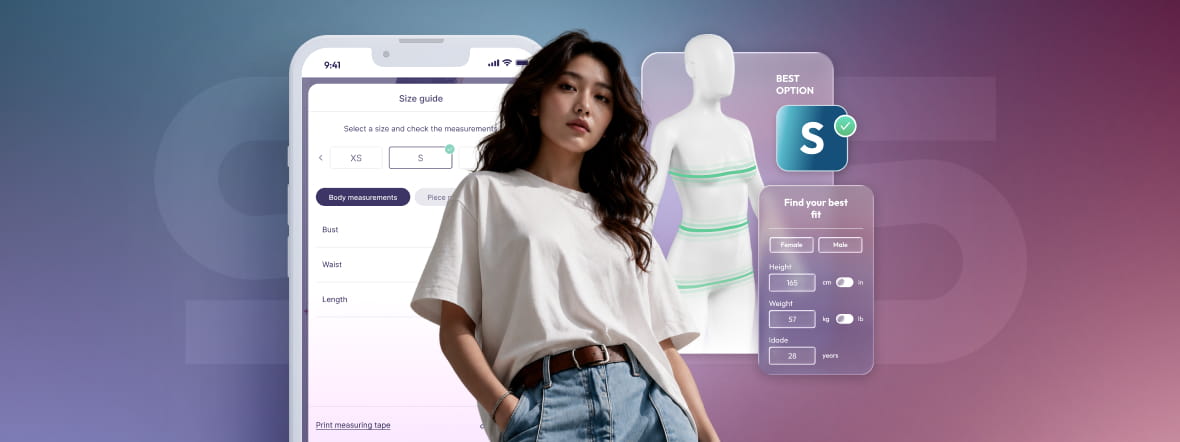
Yes, and the mechanism is straightforward. Size recommendation and virtual try-on remove the hesitation that either kills the cart or turns it into a return, and that hesitation is exactly where acquisition spend goes to die. Size recommendation tells shoppers what size to buy, while visualization shows them why it’s right. Together, they close the gap between a browser and a kept customer.
Stores using Sizebay’s Virtual Fitting Room, which combines both into a single decision experience, consistently see this play out in the numbers. Users of the tool drive up to 50% fewer returns, which directly lowers the real cost behind every acquired customer. Conversion rates run up to 5x higher, meaning more of the traffic already paid for actually turns into a sale. Repurchase rates are 40% higher, because a customer who got the right size the first time comes back without needing to be re-acquired. And average order value climbs 12%, since shoppers buying confidently add more to their cart instead of ordering multiple sizes.
Is Reducing Returns Really an Acquisition Strategy?
Yes, because the alternative is paying full acquisition cost again to replace the customer you already had. A kept sale doesn’t need a second ad budget, but a returned one does.
Where CAC Is Actually Optimized
None of this means targeting, creative, and channel mix don’t matter. They do, and getting them right is still half the job. But they only get you the click. What happens after the click, in that moment when a shopper looks at a product page and decides whether they trust the size they’re about to buy, is where the other half of your CAC gets decided.
The takeaway here is that to truly optimize CAC you need to make sure the customers you’re paying for actually stick around. It’s a quieter win than a lower cost per click, but it’s a real one and it shows up in the numbers whether your dashboard is set up to catch it or not.
If you’re serious about reducing your return rate as a means of improving your customer acquisition costs, make sure to read our article on how to reduce your store’s return rate.