
When it comes to sales strategies, most fashion e-commerce teams treat “selling more” as a traffic problem. Get more visitors, run more campaigns, launch more promotions, and revenue will follow. It’s an easy trap to fall into, because on the surface it stands to reason that driving more traffic to your product pages will increase sales.
But if you’ve been in this business for more than a season, you already know that more traffic doesn’t fix a broken decision. If shoppers are landing on your site and still leaving without buying, or buying and then returning, there’s a confidence problem that needs to be addressed. And not even the biggest media budget in the world solves a confidence problem.
So what is an effective sales strategy to boost sales in fashion e-commerce? Instead of asking “how do we get more people to our site,” you should be asking “where is revenue actually leaking, and what do we do about it.” That reframe changes where you invest, what you measure, and how you think about growth for the rest of the year.
Why Selling More Isn’t Just About More Traffic
Traffic is a vanity-adjacent metric when it’s disconnected from what happens after the click. A campaign can hit its CPM targets, drive a healthy volume of sessions, and still lose money if the product page can’t answer basic questions that drive apparel purchases, like “will this fit me?” and “will this look good on me?”
This matters because fashion is one of the only categories where the product itself is uncertain until it’s on the body. You don’t need to know if the latest iPhone matches your body before you purchase one. On the other hand, a pair of jeans might run small in one brand and large in another, and shoppers know that. That uncertainty sits on every product page, quietly working against your conversion rate no matter how good your ads are.
So when growth stalls, the instinct is to spend more to acquire more. The better instinct is to ask why the traffic you are already driving isn’t converting, and why shoppers who do convert are sending so much back. That’s where real, durable growth actually starts.
Key takeaway: Traffic growth without decision-support is just a more expensive version of the same conversion rate. Fix the decision first, then scale acquisition.
Reading the Numbers That Show Where Sales Are Being Lost
Before you touch a media plan, you need a diagnosis. Most fashion retailers already have the data to do this; it’s just scattered across systems that don’t talk to each other. Pulling it together into one view is the difference between guessing and knowing.
Start with returns by category and by size. If a specific category, like outerwear or fitted denim, runs well above your average, shoppers there are guessing more than deciding. Here, “average” means apparel overall runs around 25 percent, with shoes closer to 31.4 percent and women’s fashion around 27.8 percent.
If a category runs well past those benchmarks, that’s your signal to act first. Break it down by size too: are returns clustering at the extremes, suggesting your chart doesn’t reflect actual fit? Or spread evenly, suggesting a broader fit-confidence issue?
Reasons for returns matter as much as the returns themselves. “Didn’t fit” and “not as expected” are pre-purchase problems disguised as post-purchase costs. “Changed my mind” or “found a better price” point elsewhere, usually toward merchandising or pricing. Lumping all of these into one return rate hides exactly the insight you need.
Then there’s the customer acquisition cost (CAC) conversation most teams get wrong. Reported CAC, the number your ad platform shows, isn’t what it costs to actually keep a customer. Net CAC accounts for the returns, refunds, and customer service costs tied to a sale that never needed to happen. A campaign that looks efficient on reported CAC can be unprofitable once returns are factored in, and a 30 to 35 percent return rate in the wrong category erases that efficiency entirely. Our experience across fashion retailers shows this gap is often bigger than expected, and concentrated in the same few categories every time.
Related: What Fashion Stores Get Wrong About CAC
How do I know if my return rate is a sizing problem or something else?
Look at the reason code first. If “didn’t fit,” “too small,” or “too big” make up the majority of returns in a category, you’re looking at a sizing and fit confidence issue, not a product quality or expectation-setting issue. That distinction should drive where you invest next.
Reallocating Media Budget based on Real CAC

Once you know your net CAC by category, the next move is straightforward: stop funding growth into categories that are steadily bleeding it back out. This sounds obvious, but most media budgets are still allocated based on last year’s plan or reported CAC, not on what a category actually costs you once returns are factored in.
In practice, this means shifting spend away from high-return, high-uncertainty categories, at least until the fit experience on those pages improves, and toward categories where conversion holds and returns stay low. It also means treating “fix the fit problem” as a budget line, not a nice-to-have. If a category’s net CAC is 40 percent higher than its reported CAC, the fastest way to bring that down is giving shoppers enough information to buy the right size the first time.
This is where the two conversations, media efficiency and fit confidence, actually merge. You can’t optimize one without the other in fashion. All of this means that media strategy only works as hard as the product page lets it. Every dollar you reallocate buys you more time and more efficiency, but it’s the fit experience that decides whether that dollar turns into a kept sale or a refund.
Campaign Segmentation by Purchase Intent

Not every visitor is the same distance from a decision, and treating them all the same is one of the quieter ways fashion e-commerce teams waste budget. A shopper who’s browsed three product pages and added an item to cart is in a completely different mindset than someone who just clicked a cold prospecting ad.
Segmenting campaigns by purchase intent, top-of-funnel discovery, mid-funnel consideration, and bottom-of-funnel intent to buy, lets you match the message to where the shopper actually is. Someone in the consideration stage doesn’t need another discount code. They need reassurance: reviews, fit guidance, sizing confidence, real customer photos. Someone with high purchase intent who abandoned a cart is often abandoning over exactly one of two things: price or fit uncertainty. If it’s the latter, a coupon won’t bring them back, but better sizing information might.
This isn’t a small slice of the funnel either as fashion and apparel cart abandonment runs around 72.8 percent, and sizing uncertainty, not price or shipping, is the leading cause. The same data shows stores offering a virtual size guide, fit finder, or try-on feature see about 19 percent lower abandonment in that category, which is a direct, independent confirmation that solving the fit question at the point of hesitation recovers real revenue.
This is also where retargeting gets smarter instead of just more frequent. Instead of hitting every cart-abandoner with the same “come back” ad, you need to segment by intent and by the friction point (fit versus price versus shipping cost) to see meaningfully better return-on-ad-spend, because the message is actually solving the problem that caused the drop-off in the first place.
Prioritizing Investment in Visual Confidence by Category
Not every category carries the same level of sizing risk, and your investment in visual confidence solutions like size recommendation tools and virtual try-on should reflect that. A basic cotton t-shirt in one size range is a low-risk purchase. A structured blazer, a fitted dress, or a shoe with a narrow toe box is a high-risk one, and shoppers know it, which is exactly why those categories tend to carry higher bounce rates and higher returns.
The practical move here is to prioritize where you add sizing and visualization support based on where uncertainty is actually costing you money, not roll it out evenly across the whole catalog. In practice, that means those same high-risk categories: fit varies the most there, and shoppers are least willing to guess.
You need to treat visual confidence as infrastructure, and build it into the categories where the data shows shoppers actually need it. That kind of prioritization is what turns a nice feature into a real driver of conversion and AOV.
Retention as a Growth Strategy
It’s tempting to think of growth purely in terms of new customers, but the shoppers you already have are a far cheaper source of revenue, and they’re often the most overlooked line in the sales strategy. A customer who buys once and returns half the order rarely buys again. A customer who buys once and keeps the whole order almost always does.
Getting the size right the first time builds trust in the brand’s sizing system, and that trust is what brings a shopper back without needing another acquisition campaign to do it. So if your growth plan is entirely acquisition-weighted, it’s worth asking what percentage of this quarter’s revenue could come from simply keeping more of the customers you already converted. Often, the answer reframes the whole budget conversation.
Bringing in Voices Shoppers Actually Trust

Paid media and product pages can only do so much to build confidence. Shoppers increasingly look to people who look like them, wearing the product in real conditions, before they trust a size chart alone. That’s why influencer partnerships and user-generated content have become such an important sales strategy for fashion retailers. Seeing real people wear garments in real life helps answer the fit question in a way a spec sheet never can. The numbers back this up with 79% of shoppers saying user-generated content highly impacts their buying decisions, and specifically in fashion, more than 66 percent of people decide whether to buy clothing based on reviews and comments from other shoppers.
When looking for creators to partner with, you don’t need to look for big names or creators with large followings. Instead, look to work with creators whose body type and style resonate with your actual customer base, and pair that content with real customer photos and reviews on product pages. Seeing someone with a similar build wearing a specific size closes the confidence gap in a way no amount of ad spend can replicate. It’s a low-cost, high-trust addition to a sales strategy that’s often underused simply because it’s harder to attribute in a dashboard than a paid campaign.
Read More: What is UGC Creator and how to use it in fashion e-commerce?
Returns Are a Pre-Sale Problem
Finally, let’s talk about the mindset shift that ties everything above together. Most teams treat returns as a logistics and customer service issue, something to manage after the fact with better packaging or a smoother return process. But that’s treating the symptom when in reality the return started the moment the shopper had to guess.
Every return tied to “didn’t fit” was a decision made with incomplete information at checkout. The shopper wasn’t wrong to guess, they just didn’t have anything better to go on. Which means the fix isn’t a better returns process, but giving shoppers what they need to get it right the first time, before the order ever ships. That single reframe, from post-sale cleanup to pre-sale prevention, is what separates teams that are still firefighting returns from teams that are actually reducing them.
Key Takeaway: A lower return rate is a sign that shoppers made better decisions upfront, and that’s a sales strategy outcome, not an operations one.
Resolving Uncertainty Before Purchase as a Sales Strategy
This is where the diagnosis, the budget reallocation, and the retention math all point to the same solution. Shoppers need help answering “will this fit me” before they click buy, not after they’ve already committed to a size and started waiting for the box.
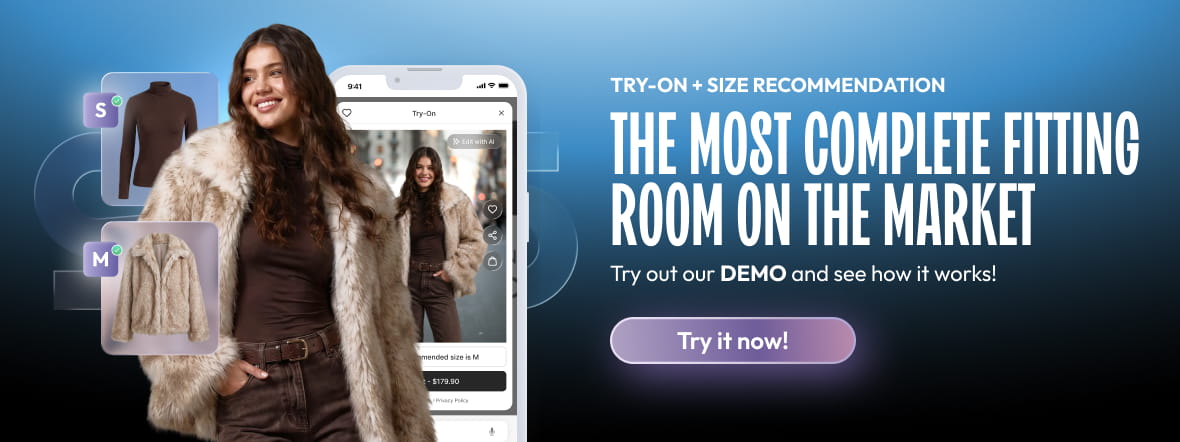
This is exactly what Sizebay’s virtual fitting room is built to solve, combining size recommendation with visualization so shoppers can see how an item will actually look and fit on a body like theirs, not just read a size chart and hope for the best. It’s not a single feature bolted onto a product page. It’s a complete decision experience that replaces guesswork with information at the exact moment a shopper is deciding whether to buy.
The results follow directly from that shift. Retailers using Sizebay’s combined size recommendation and virtual try-on experience see:
- Up to 5x higher conversion rates;
- Up to 50% fewer returns;
- A 12% increase in average order value;
- 40% higher repurchase rates, as shoppers learn they can trust getting the size right on the first try.
Schedule a demo with our team by clicking in the top-right corner to learn more about our solutions and how they can be a part of an effective fashion e-commerce sales strategy.
The results happen because shoppers who feel confident about fit are also more willing to add a second item to the cart. None of that comes from a bigger media budget. It comes from removing the one piece of uncertainty that was costing you sales all along.