

Picture a shopper scrolling Instagram on a Tuesday night. A jacket catches her eye on a creator’s page. She taps through, adds it to her cart, then closes the tab because dinner’s ready. Two days later she’s walking past the store and pops in to try it on. Wrong size on the rack — so she checks the app instead. That evening, she finally finishes the purchase from her laptop.
That’s just how people shop for clothes now. They move between social, mobile, in-store, and desktop without giving it a second thought, and they expect brands to keep up.
Most fashion brands aren’t built that way, though. The store team runs the store, the app team runs the app and marketing runs the ads. Each one keeps its own goals, its own data, and often its own picture of who the customer even is.
Shoppers don’t see any of those internal boundaries, they just feel the friction when the boundaries show up: a cart that doesn’t carry over, a size that’s available online but not in the store they just visited, a promo that only works on the app.
Two problems sit stacked on top of each other here. Omnichannel marketing is about how a brand shows up and gets discovered across the channels shoppers actually use. Omnichannel customer experience is about what happens once that shopper engages, and whether the experience holds together from first click to final purchase. This post covers both, because in practice they’re hard to build apart from each other.
What Omnichannel Actually Means for a Clothing Brand
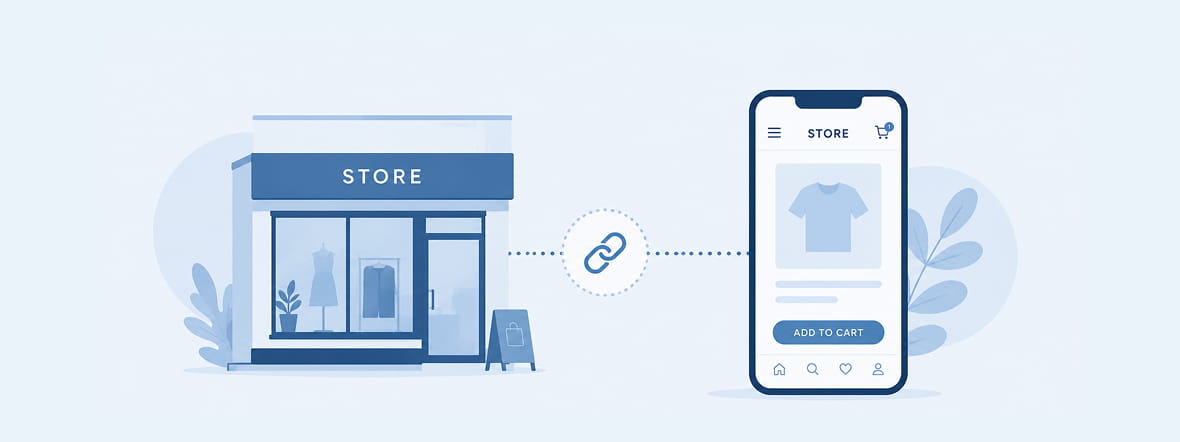
Omnichannel means every channel a brand runs, app, website, store, marketplace listings, social, works as one connected system instead of separate silos. That’s what a genuine omnichannel customer experience looks like in practice: a shopper’s cart, history, and offers carry over no matter where they show up next.
The connection is the part that matters. A brand can run a website, an app, a physical store, and listings on three marketplaces and still be purely multichannel: each one its own silo, with its own inventory, its own promotions, and no memory of the customer moving between them.
Is Omnichannel Just a Bigger Budget Version of Multichannel?
No, and it’s worth clearing this up early, because budget usually isn’t the first constraint brands run into. Data and systems are. A brand can spend heavily on ads and still deliver a broken experience if the app has no idea what happened on the website an hour earlier. Omnichannel is a connection problem before it’s a spending problem. Brands that treat it as “more channels, more budget” tend to end up with more friction, not less.
Related: Consumer Buying Behavior in the Fashion E-commerce Funnel
Why Fragmented Channels Cost Fashion Brands Money
Siloed channels leak money quietly, mostly by wearing down shopper trust before anyone notices why. A dress sells out on Instagram before the feed catches up. The app price runs five dollars under the website. A loyalty member walks into the store, and the associate has no idea she’s a repeat customer. None of that feels catastrophic on its own. It adds up fast, though, and each disconnect chips away a little more at the omnichannel customer experience shoppers now expect as the baseline, not the exception.
For growth teams, that shows up as numbers getting misdiagnosed. Cart abandonment gets blamed on price when the real issue is inconsistent information. Repurchase rate drops, not because the product disappointed anyone, but because the experience felt disjointed. Support tickets pile up over orders that never synced. Different symptoms. Same root cause: channels that don’t talk to each other.
The cost is measurable, too. According to Capital One Shopping Research, omnichannel shoppers spend about 16% more per order than single-channel shoppers, on average, and deliver roughly 30% higher lifetime return on investment. Retention tells the same story from a different angle: brands with connected omnichannel engagement keep an average of 89% of their customers, compared to just 33% for retailers stuck on a single channel.
Where Fashion Shoppers Actually Discover and Decide

Everything so far has been about experience: what happens once a shopper is engaged. The other half is discovery, how shoppers find products in the first place, and it has shifted faster than most brands have caught up to. According to Capital One Shopping Research, most shoppers don’t stick to one channel, touching an average of 11 touchpoints before completing a purchase.
Reach and trust rarely show up together. Social platforms, through creators and short video, bring the most reach and the least built-in trust, since a shopper sees the product before knowing anything about the brand. Search sits at the opposite end: smaller reach, real intent, since the searcher already knows what they want. Marketplaces land in the middle on reach, though they strip out brand identity almost completely. Email and SMS reach fewer people but carry the most trust, since those people opted in. Retail media, ads inside other retailers’ sites, is the newest attempt to get both reach and intent.
Discovery and decision used to be separate moments; now they merge into one. A shopper doesn’t see a jacket on TikTok and research it later; she wants to decide right there. Too many gaps between that moment and a confident purchase, and she moves on, which is why marketing and the omnichannel customer experience can’t keep operating as separate teams with separate goals.
Take a TikTok ad that performs well: strong watch time, solid click-through. The shopper lands on a page with none of the context that made the video convincing, no reviews, no sizing guidance, nothing showing how the piece looks on a real body. The ad did its job but the page didn’t. That mismatch rarely shows in the dashboard, since the metrics still look fine.
What Omnichannel Customer Experience Looks Like in Practice
It helps to ground this in brands that have actually done the connecting work, rather than treat a strong omnichannel customer experience as a theoretical ideal.
Sephora’s Beauty Insider program is a common reference point: the same loyalty profile, purchase history, and product recommendations follow a member whether she’s browsing the app on the train, scanning a product in store, or shopping the desktop site at home, so the store associate and the app are effectively working off the same customer record instead of two different ones.
Nike has pushed hard on tying its app to physical stores: scan-to-buy in flagship locations, member-only product access, and reserved sizes that a shopper claims on the app and picks up in person. The store stops being a separate transaction and becomes another checkpoint in the same relationship the app already started.
Zara’s operational bet has been real-time inventory. RFID tagging lets the brand show shoppers accurate stock, down to the individual store, instead of a number that’s a day stale, which is precisely the kind of “cart resets, size disappears” friction this article keeps coming back to.
Worth noting: the specifics of any brand’s current tech stack shift over time. Verify the latest details before quoting them externally, but the underlying pattern, one customer record, one inventory truth, holds up as the benchmark to aim for.
Why Cross-Channel Attribution Is So Hard, and What to Do About It

Six or more touchpoints before a purchase creates a measurement problem that most marketing dashboards were never built to handle, and it’s part of why measuring the omnichannel customer experience honestly is so much harder than measuring a single channel. Last-click attribution hands full credit to whichever channel happened to close the sale, usually paid search or a coupon code, while the TikTok video or the in-store browsing session that actually started the shopper’s interest gets nothing.
Over time, that misattribution quietly defunds the channels that create demand in favor of channels that just harvest it. A brand cuts the influencer budget that was driving discovery because the spreadsheet says search converts better, without realizing search was only converting because the influencer content did the persuading three days earlier.
A few fixes are within reach of most teams, even without an enterprise attribution platform:
- Use a unified customer ID across channels so a single shopper’s touchpoints can actually be stitched together into one journey instead of six anonymous sessions.
- Look at assisted conversions, not just last-click, when evaluating whether a channel earns its budget.
- Run holdout or incrementality tests on at least one channel, turn it off for a defined region or audience and watch what happens downstream, since that tells you more than any attribution model’s guess.
- Treat attribution as directional, not exact. The goal is better budget decisions, not a perfect accounting of credit.
Building a Consistent Omnichannel Customer Experience
Once discovery and decision are happening together, consistency becomes the thing that actually determines whether a channel converts. A consistent omnichannel customer experience means the same product data, the same promotions, the same loyalty recognition, and the same visual identity, no matter where the shopper encounters the brand.
It sounds obvious stated that plainly. It’s operationally hard, which is exactly why so few brands pull it off. A customer with three items in her app cart should see those same three items if she opens the site on her laptop that night, not an empty cart that makes her start over and maybe reconsider the purchase altogether. Getting there takes product data syncing, inventory management, and loyalty systems that actually talk to each other, but it’s the backbone everything else depends on.
A few practical ways to build that consistency:
- Customer profiles should follow shoppers across app, site, and store, so loyalty status, browsing history, and cart contents don’t reset when they switch devices.
- Every channel should pull from the same inventory feed, not a nightly export that’s already stale by the time a shopper checks it.
- A shared design system keeps product photography, sizing language, and visual identity looking like the same brand no matter where someone lands.
- Returns and exchanges should work the same regardless of where the item was bought. A shopper who ordered online should be able to return in store without an argument at the counter, and the reverse should hold too.
Mobile and In-Store as Connected, Not Competing, Channels
There’s a persistent myth in fashion retail that digital and physical stores compete, that every dollar spent on mobile somehow cannibalizes the store. Real shopping behavior doesn’t back that up. 83% of shoppers research online before going to a store, checking reviews, comparing sizes, and confirming what’s actually in stock at that location before making the trip.
The spending pattern backs this up too. According to Capital One Shopping Research, shoppers who spend $100 online and then visit the brand’s physical store within 15 days spend an average of $131 more. The reverse path, spending in-store first and then visiting the online store, drives even more: an additional $167 on average.
What’s changed is the expectation on the other side of that research. A shopper who’s built a wishlist on the app expects a store associate to be able to see it, or at least not treat her like a stranger. QR codes that link a rack display to the full online catalog, mobile checkout that skips the line, associates with access to a customer’s online browsing and purchase history: these matter for brands that want the store to feel like part of the same omnichannel customer experience as the app, not a separate transaction.
Does Investing in Mobile Hurt In-Store Sales?
Generally, no. Mobile research tends to increase confidence before a store visit rather than replace it. The bigger risk isn’t mobile pulling shoppers away from stores. It’s a disconnected mobile experience that sends a confused, under-informed shopper into the store, or a store experience that ignores everything the brand already knows about her from that mobile activity.
How to Start Building an Omnichannel Strategy

None of this gets fixed by adding another channel. It gets fixed by connecting the ones already in place. A practical starting sequence:
- Map the current customer journey channel by channel, and be honest about where it breaks. Where does a shopper lose her cart, hit inconsistent pricing, or hit contradictory information between channels?
- Unify product, inventory, and customer data before adding anything new. A fifth channel built on the same fragmented data just multiplies the problem.
- Pick two or three channels to connect deeply before expanding. Trying to unify everything at once usually means nothing gets done well.
- Align marketing and customer experience teams around shared metrics. If marketing is measured on clicks and CX on tickets, nobody owns the gap between them, and that’s where shoppers fall through.
- Decide who owns this. Omnichannel work stalls when it’s nobody’s specific job. Some brands centralize it under a unified-commerce team; others fold it into CX. Either can work, but ambiguity can’t.
- Test with a clear before-and-after metric. Returns, repurchase rate, and average order value are sensitive to how connected the experience feels, and they’ll tell you honestly whether the changes worked.
Budget size isn’t what determines whether this works.
A smaller fashion brand doesn’t need to unify every channel at once. Connecting two or three, say, the site, the app, and one marketplace, delivers most of the benefit without the systems overhaul a larger, fragmented brand needs.
It’s also worth setting realistic timing. A genuinely connected omnichannel customer experience across two or three channels is doable within six to twelve months, assuming the data is reasonably clean to start. Brands beginning from badly fragmented systems should expect closer to twelve to eighteen.
Related: Sales Strategies to Boost Your Fashion E-Commerce
What to Expect From Good Omnichannel Marketing and Customer Experience
When channels are actually connected, the impact shows up in numbers growth teams already track, just moving in the right direction.
Returns tend to drop, since shoppers have consistent, accurate information no matter where they engage, so fewer purchases get made on guesswork. Repurchase rate climbs because the experience feels coherent enough to trust a second and third time.
Average order value tends to rise too: a shopper who trusts the brand across channels adds to her cart instead of buying cautiously and hoping for the best.
Conversion improves across the board, because every one of those small frictions, the mismatched cart, the outdated stock listing, was a small reason to hesitate, and removing them removes the hesitation with it.
All of this comes from treating a shopper’s path as one continuous omnichannel customer experience instead of a series of channel-specific projects running in parallel. For other ways to push your store’s marketing further, read our introduction to fashion e-commerce marketing.