
Consumer buying behavior in fashion e-commerce follows a pattern that’s easy to misread if you only look at the surface metrics. This piece walks through what the fashion funnel actually looks like in practice.
We’ll cover the behavioral signals that predict a lost sale, and why fashion sees higher abandonment than other categories. We’ll also cover what to do once you can read those signals.
To set the scale of the problem, the Baymard Institute puts average cart abandonment across e-commerce at just over 70%. That figure is based on 50 separate studies.
But in fashion specifically, cart abandonment consistently runs above that baseline. That gap is one of the clearest signs that something category-specific is driving hesitation, beyond ordinary checkout friction.
The Fashion E-commerce Funnel, In Practice

The textbook funnel is tidy: shoppers move from awareness to consideration, then to purchase. That framework holds up fine for most categories.
But fashion stretches and complicates each stage in ways a generic retail funnel doesn’t account for. Reading consumer buying behavior correctly here means looking past the standard funnel model.
Awareness in fashion, for instance, is often more about discovering the right brand than discovering that a brand exists. Shoppers usually know dozens of options already.
So awareness is really about which specific product surfaces at the right moment, whether through a social post, a search result, or a retargeted ad. In other words, the volume of choice is the friction here, not the lack of it.
Consideration is where fashion diverges most from other retail. In electronics or home goods, consideration is mostly about comparing features and price.
In fashion, though, a large part of consideration is spent trying to mentally answer a question the product page usually can’t resolve: “will this actually fit and look right on my body?” That question simply doesn’t exist in the same way when someone’s comparing blenders.
For this reason, shoppers constantly spend real time in consideration and still leave without a clear answer. This happens whenever they can’t resolve the fit question through browsing alone.
How fashion funnel really works
What we have to consider here is that purchase, in theory, is just the final click. In practice, for fashion, it’s often where that unresolved consideration-stage doubt resurfaces.
A shopper who moved forward without full confidence in their size is more likely to hesitate again right before paying. This is why purchase-stage abandonment is frequently a delayed symptom of a consideration-stage problem, not a new objection.
So the classic funnel still applies, but each stage carries a fashion-specific weight. That weight shapes how shoppers actually move through it.
Zooming in further, here’s roughly how that plays out once a shopper acts on that awareness moment and lands on the site. Here’s where friction tends to build at each step from there:
- Browsing: Too many similar options and inconsistent fit guidance across brands make it hard to know where to even start comparing.
- Product page: Great photography and product descriptions can’t answer the one question that matters most: how will this actually fit and look on me?
- Size selection: This is where hesitation quietly peaks. Shoppers toggle between sizes, check the size chart, leave, and come back.
- Cart: Doubt resurfaces here even after a shopper has committed to a size, often triggered by thinking ahead to the return process.
- Checkout: The same fit uncertainty that showed up on the product page can resurface here, undoing progress that looked like commitment.
Taken together, the important thing to notice is that abandonment isn’t one event that happens at checkout. It’s actually the accumulation of small, unresolved doubts that build across every stage before it.
A shopper who hesitated at the size chart on the product page is already a flight risk long before they ever reach the cart.
Where in the funnel do most fashion shoppers actually drop off?
Most teams assume checkout is where they lose the sale, since that’s where the abandoned cart gets logged. In practice, though, the decision is usually made earlier, at the size-selection stage.
Checkout abandonment is often just the final, visible symptom of doubt that started back on the product page.
Related: An Introduction to Fashion E-Commerce Marketing
The Main Behavioral Signals That Indicate Risk of Non-Purchase
Once you know where hesitation begins, the next step is identifying it before shoppers abandon their carts. That requires looking beyond surface metrics like time on page, which only show that someone is browsing, not why they haven’t purchased.
Understanding these signals means analyzing consumer buying behavior at a granular level. In fashion e-commerce, several recurring behaviors reveal when uncertainty is preventing a purchase:
- Repeated visits to the size chart or size guide. This usually signals fit uncertainty rather than price sensitivity. Shoppers checking sizing information multiple times are typically trying to avoid ordering the wrong size.
- Switching between sizes before adding an item to the cart. This real-time indecision is one of the strongest indicators of a future return or an abandoned purchase.
- Adding a product to the cart without reaching checkout. The shopper has shown purchase intent, but doubts about fit or the hassle of returns often stop the transaction.
- High product page engagement with a low add-to-cart rate. This suggests genuine interest but insufficient confidence. Shoppers like the product but remain uncertain about its fit.
- Returning to the same product across multiple sessions without converting. These shoppers haven’t rejected the item—they simply haven’t gained enough confidence to complete the purchase.
Although these behaviors appear different, they often point to the same underlying problem. Some shoppers browse repeatedly, while others hesitate at checkout or revisit the same product several times.
In our experience working with fashion brands, what appears to be comparison shopping or price sensitivity is usually unresolved fit uncertainty. While consumer buying behavior varies from shopper to shopper, the root cause behind fashion cart abandonment is often the same: uncertainty about size and fit.
Cart Abandonment: Causes Specific to Fashion E-commerce
Some causes of fashion cart abandonment are universal across retail, including unexpected shipping costs, forced account creation, and lengthy checkout processes. Industry surveys show that about 39% of online shoppers abandon their carts because of unexpected costs, while 21% leave due to slow delivery.
Although these factors matter, they affect every retail category. What makes fashion e-commerce different is fit uncertainty, one of the biggest drivers of abandoned purchases.
Unlike price or shipping, shoppers can’t verify how a garment will fit before buying. Fashion sizing isn’t standardized, and the same size can vary significantly between brands. A medium from one retailer may fit like a small from another, making previous purchases an unreliable reference and creating uncertainty throughout the buying journey.
The fear of returns amplifies this hesitation. Many shoppers add products to their carts intending to decide later, while others never add them because the potential hassle of returning an ill-fitting item already feels too costly. Without a realistic way to visualize how clothing will look and fit on their own body, shoppers are forced to imagine the outcome.
Understanding consumer buying behavior means recognizing that this hesitation usually reflects uncertainty, not a lack of interest. In many cases, shoppers want the product but lack the confidence to complete the purchase.
The business impact extends beyond a single lost sale. Shoppers who abandon their carts because of fit uncertainty are still evaluating alternatives and haven’t developed loyalty to a specific brand. If a competitor answers the fit question first, that purchase often happens elsewhere.
Ultimately, fit uncertainty doesn’t only increase fashion cart abandonment. It also weakens customer loyalty by making purchase decisions depend on whichever retailer removes doubt first.
Read more: Why clothing sizes are inconsistent across brands
Is fashion cart abandonment really different from other retail categories, or is it the same problem everywhere?
The mechanics of abandonment look similar across categories: unexpected costs, complicated checkout, hesitation before payment. What’s different in fashion is the underlying cause.
In most retail categories, price and shipping drive the decision. In fashion, however, fit uncertainty sits underneath the visible friction, and often explains it.
Read More: How to reduce cart abandonment rates in fashion e-commerce
Fashion’s Specific Pain Point

Because fit uncertainty underlies many causes of fashion cart abandonment, it deserves special attention.
Unlike color or style, size and fit aren’t preferences. They depend on brand, garment cut, fabric, and body shape. Shoppers can’t accurately verify fit before buying unless they try the product on or use a reliable virtual fitting solution that predicts the right size.
This uncertainty creates behaviors that conversion metrics alone rarely reveal. One example is size bracketing, where shoppers order the same item in multiple sizes, intending to keep one and return the rest.
According to a UK survey, 62% of consumers admit to size bracketing. While it’s a rational response to uncertainty, it inflates return rates, increases operational costs, and distorts demand forecasting. Products that appear to be bestsellers may actually be generating duplicate purchases that later become returns.
In fashion e-commerce, size and fit issues account for up to 70% of apparel returns, making them the leading cause of product returns. Incorrect sizing generates more returns than damaged items, inaccurate product information, delivery mistakes, or post-purchase changes of mind.
The financial impact is substantial. In 2025, product returns generated an estimated $849.9 billion in returned merchandise for U.S. retailers. Apparel remains one of the largest contributors because shoppers can’t verify size and fit before checkout, unlike price, color, or product details.
Most importantly, fit uncertainty affects shoppers long before checkout. Many never add an item to the cart because they’re already calculating the inconvenience of a possible return while browsing. By the time a cart abandonment email is sent, the purchase decision was often made much earlier—while the shopper was still trying to interpret the size chart.
How Reading Consumer Buying Behavior Connects to Practical Action
Understanding these signals only matters if it changes what your team actually does. Watching size-chart visits spike on a product page is interesting data, but it isn’t useful until someone acts on it.
Here’s how the signals from the previous section should translate into action, not just observation:
- High size-chart engagement, low conversion: Needs stronger, more personalized sizing support at that exact point, not a full product page redesign.
- Abandonment right after size selection: Needs more confidence before checkout, not a lower price.
- Repeat visits without a purchase: Usually means the shopper is still deciding on size or picturing fit, not comparing prices elsewhere.
Most teams, however, respond to all three the same way: a discount email, a countdown timer, an urgency banner. That treats the symptom rather than the cause described above, and it carries a longer-term cost too.
Roughly 32% of customers say they’d stop shopping with a brand entirely after a single bad experience. Receiving an item that doesn’t fit is one of the most common versions of that experience.
A discount might win back a single sale, but it won’t rebuild the trust a shopper loses the moment a size guess goes wrong. Once you accept that the real friction is confidence in sizing, not price or urgency, the next step becomes clear.
Give shoppers a way to resolve that uncertainty before they reach the cart, not after they’ve already started to leave.
We already send abandoned cart emails. Why isn’t that solving the problem?
Abandoned cart emails are built to bring shoppers back to a decision they already didn’t make. If the reason they left was fit uncertainty, the email doesn’t change that.
The shopper simply returns to the same unresolved doubt. So the email, at best, delays the abandonment rather than preventing it.
The Virtual Fitting Room as a Direct Response to Indecision
Everything covered in this funnel points to the same conclusion about consumer buying behavior: shoppers hesitate at predictable points. Fit uncertainty is usually the real cause underneath it, not price or shipping.
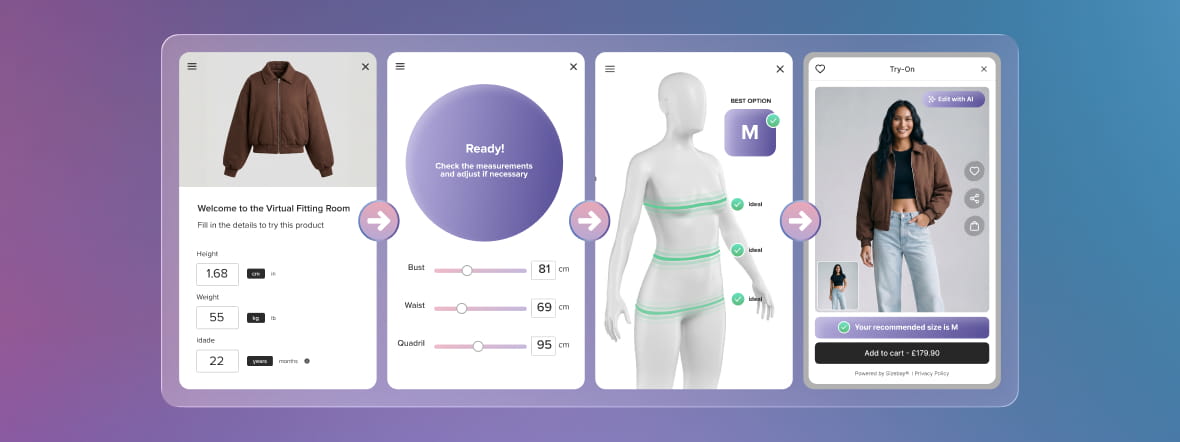
This is exactly the gap our Virtual Fitting Room is built to close. It works through size recommendation and virtual try-on, functioning as one connected experience rather than two separate features.
Size recommendation tells shoppers what size to order, while virtual try-on lets them see what a garment looks like on their own body. Together, they resolve the hesitation covered throughout this piece, right on the product page, before the shopper ever reaches a cart to abandon.
A note on the numbers below: unlike the industry statistics cited earlier in this piece (Baymard Institute, UK consumer surveys, U.S. retail return data), the following figures come from our own first-party data.
They’re aggregated results reported by brands actively using our Virtual Fitting Room, not third-party or independent research. We’re sharing them because they’re the actual outcomes we track with clients, but they should be read as our own product performance data, not an industry-wide benchmark.
Based on that first-party data, brands using our solution have seen:
- Up to 5x higher conversion rates
- Up to 50% fewer returns
- A 12% increase in average order value
- 40% higher repurchase rates, as shoppers learn they can trust getting the size right on the first try
If you’d like to learn more about our solution and how it can improve your store’s performance, feel free to schedule a demo by clicking in the top right corner.